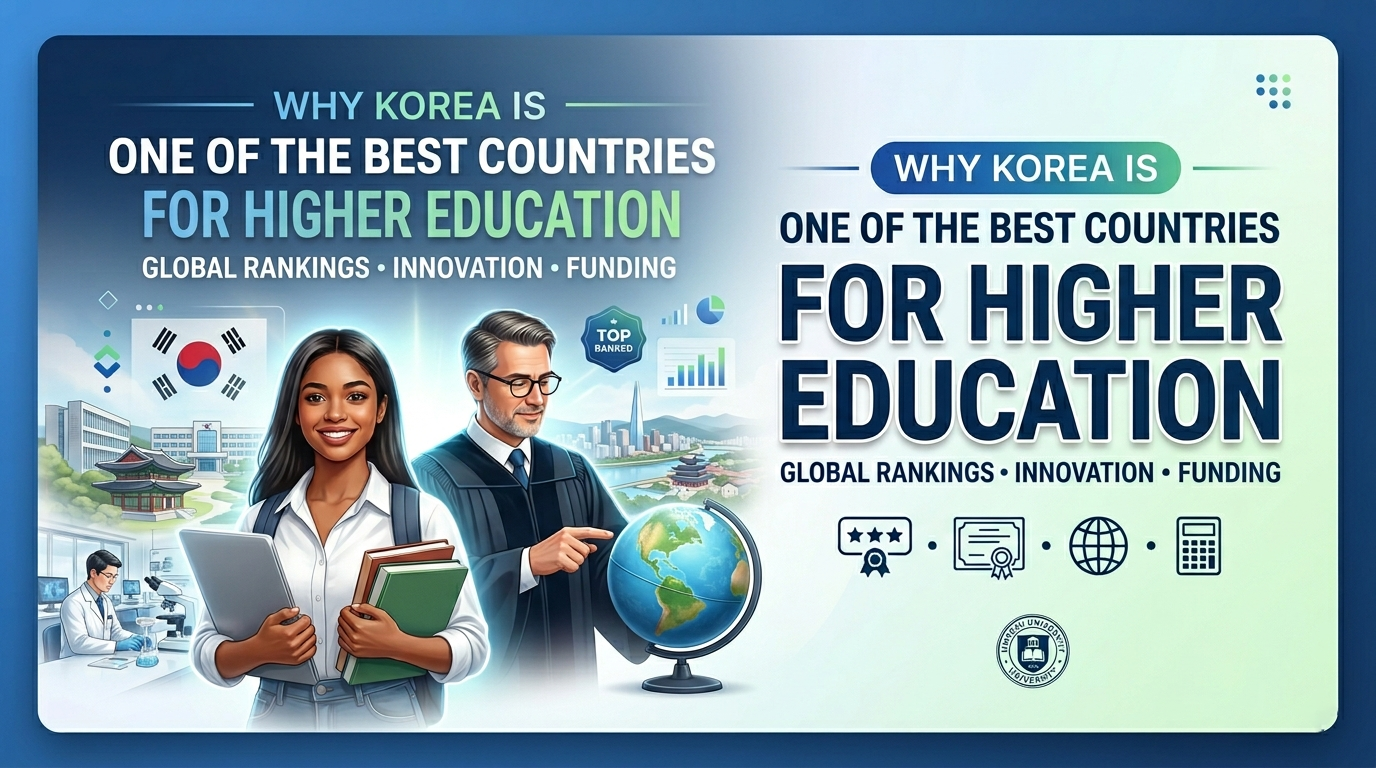
Why Korea Is One of the Best Countries for Higher Education
Introduction: A New Dream Destination for Students
Imagine studying at a university where world-class professors, cutting-edge research facilities, and a rich cultural experience all come together under one roof. Picture walking through a vibrant campus where ancient traditions blend seamlessly with futuristic technology. For thousands of international students every year, this is not just a dream — this is student life in Korea.
For many students, choosing the right country for higher education is one of the biggest decisions of their lives. Unfortunately, worries about quality, safety, affordability, language barriers, and future career prospects make this decision even harder. However, finding a country that checks all these boxes is not impossible — and Korea does exactly that.
Indeed, South Korea has quietly but confidently emerged as one of the top destinations for international students around the world. With globally ranked universities, generous scholarships, a safe environment, and an exciting modern culture, Korea offers an experience that is genuinely hard to match. Whether you are interested in technology, medicine, business, arts, or engineering, Korean universities have something exceptional to offer.
Throughout this guide, we will take a deep dive into everything you need to know about why Korea is the right choice for your higher education journey. Additionally, if you are wondering how to start this journey, we will also tell you about the best partner to help you get there.
Start Your Korea Journey with Celta Educare Chabahil Consultancy — Nepal’s Most Trusted Study Abroad Partner
Why Choose Celta Educare Chabahil Consultancy to Study in Korea?
Before we explore all the incredible reasons to study in Korea, let us talk about something equally important — how to get there with confidence and the right support.
Thousands of students across Nepal widely regard Celta Educare Chabahil Consultancy as the best education consultancy for those who wish to study in South Korea. Here is exactly why so many students trust Celta Educare with their future:
- Expert Korea Specialists: The team at Celta Educare has in-depth, up-to-date knowledge of Korean universities, admission processes, visa requirements, and scholarship opportunities. They do not guess — they know.
- High Visa Success Rate: Getting a student visa can be stressful, but Celta Educare has an outstanding record of successful visa applications. Their experienced counselors guide students step by step through the entire visa process.
- University Tie-ups and Direct Admissions: Celta Educare has strong partnerships with reputed Korean universities, which means students benefit from smoother admissions and sometimes priority processing.
- Scholarship Guidance: Celta Educare actively helps students identify and apply for Korean government scholarships (like KGSP), university scholarships, and other funding options — helping students save significantly on tuition fees.
- End-to-End Support: From choosing the right university to preparing documents, language test preparation, pre-departure briefings, and post-arrival assistance, Celta Educare supports students at every single stage.
- Proven Track Record: With hundreds of successful placements in Korean universities, Celta Educare has built a reputation that speaks for itself.
Ultimately, if you are serious about building your future through student life in Korea, Celta Educare Chabahil Consultancy is, without doubt, the smartest first step you can take.
Why Korea Stands Out in Global Higher Education
Notably, South Korea is no longer just known for K-pop and K-drama. Over the past two decades, it has become a global powerhouse in education, innovation, and research. Here is what makes student life in Korea truly exceptional.
1. World-Class Universities
Korea is home to some of the most prestigious universities in Asia and the world. Institutions like Seoul National University (SNU), KAIST, POSTECH, Yonsei University, and Korea University consistently rank among the top universities globally. Furthermore, these institutions attract brilliant minds from across the world and deliver programs led by internationally acclaimed faculty.
In fact, QS World University Rankings regularly features several Korean universities within the top 100 globally — a remarkable achievement for a country of its size. As a result, international students studying at these institutions earn a degree that carries genuine weight in boardrooms and research labs worldwide.
2. Affordable Education with Excellent Scholarship Opportunities
One of the most attractive aspects of student life in Korea is affordability compared to Western countries. Tuition fees at Korean universities are significantly lower than those in the US, UK, or Australia. Additionally, the Korean government and many universities offer generous scholarships specifically designed for international students.
The Korean Government Scholarship Program (KGSP), also known as GKS (Global Korea Scholarship), is particularly well-known among international applicants. In particular, it covers full tuition, a monthly stipend, housing, and even Korean language training. Especially for students from developing countries, this scholarship can be truly life-changing.
- KGSP Scholarship: Full tuition + living allowance + airfare coverage
- University-funded scholarships: Partial to full tuition waivers
- Research grants and assistant positions for graduate students
- Exchange programs with reduced or waived fees
3. A Safe Country with a High Quality of Life
Safety is a major concern for students — and especially for parents. Importantly, South Korea consistently ranks as one of the safest countries in the world. Violent crime rates stay extremely low, authorities actively monitor public spaces, and international students genuinely appreciate the strong overall sense of order and security.
Moreover, Korea offers a remarkable quality of life that goes far beyond safety. The public transportation system is world-class — fast, punctual, clean, and affordable. Consequently, cities like Seoul, Busan, and Daejeon function as modern metropolises with excellent healthcare, entertainment, shopping, and dining options that ensure students never feel isolated or bored.
4. Cutting-Edge Technology and Research Environment
If you are passionate about technology, engineering, or scientific research, Korea is undoubtedly one of the best places in the world to pursue your studies. Furthermore, South Korea is home to global tech giants like Samsung, LG, and Hyundai, and the country’s research infrastructure is second to none.
Korean universities invest heavily in research and development. As a result, students gain access to state-of-the-art laboratories, research centers, and collaborative projects with industry leaders. This combination gives international students a unique competitive edge — blending strong academic foundations with real-world industry exposure.
5. Vibrant and Enriching Student Life in Korea
Student life in Korea is genuinely exciting and full of opportunities. Their campuses buzz with vibrant communities packed with clubs, cultural festivals, sports events, and social activities. Moreover, Korean students and faculty warmly welcome international peers, who often find it remarkably easy to build lasting friendships across cultures.
Beyond campus boundaries, Korea’s cultural richness is truly unmatched. You can explore historic palaces and temples in the morning, then enjoy the neon-lit streets of Hongdae at night, and even take a weekend trip to stunning mountain parks or coastal cities. Notably, the food culture alone — from Korean BBQ to vibrant street food markets — is an extraordinary experience in itself.
In addition, many Korean universities have dedicated International Student Centers that help new arrivals adjust, organize cultural excursion programs, and provide ongoing language support. This welcoming structure makes the transition into student life in Korea smooth and genuinely enjoyable.
6. Korean Language — An Invaluable Career Asset
While many Korean universities now offer degree programs fully in English, learning the Korean language adds tremendous long-term value to your professional profile. Korean is the language of one of the world’s top economies, and therefore, fluency opens doors to careers at multinational Korean companies, the K-content industry, and diplomatic or academic roles worldwide.
Typically, international students who arrive in Korea without Korean language skills receive strong support, as universities actively run dedicated language programs tailored for newcomers. Eventually, within a year or two, many of these students achieve conversational fluency — a skill that continues to serve them for decades to come.
7. Strong Career and Employment Prospects
A degree from a reputed Korean university significantly boosts your global employability. South Korea’s economy connects deeply with global markets, and consequently, employers worldwide actively seek and respect graduates from Korean institutions. Besides academic credentials, Korea’s strong ties with industries like semiconductors, automotive, pharmaceuticals, and IT create excellent internship and job opportunities for students.
Furthermore, for students who wish to stay and work in Korea after graduation, the Korean government has been gradually expanding post-study work visa options for international graduates — making Korea increasingly attractive as a long-term career destination.
8. Korean Culture — A Truly Unique Experience
Beyond academics, the cultural experience of living in Korea is something students remember for a lifetime. Additionally, Korean society places high value on respect, community, and academic achievement — values that naturally create an inspiring environment for personal and professional growth.
During your time in Korea, you will celebrate Korean Lunar New Year, experience traditional tea ceremonies, witness cherry blossom festivals, and immerse yourself in a culture that is simultaneously deeply rooted in history and boldly modern. Furthermore, this cultural enrichment adds a personal dimension to education that no classroom anywhere in the world can fully replicate.
How to Apply for Korean Universities — A Quick Overview
Generally speaking, applying to Korean universities involves several clear steps. While the process varies slightly by institution, here is a practical roadmap to get you started:
- Choose your program and university carefully based on your academic background and career goals.
- Check language requirements — Korean or English proficiency tests may be required depending on the medium of instruction.
- Prepare your academic documents — transcripts, recommendation letters, statement of purpose, and passport copies.
- Apply for scholarships simultaneously with your university application to maximize your chances.
- After receiving an acceptance letter, apply for a D-2 (student) visa through the Korean embassy.
- Arrange accommodation — most universities have affordable dormitories available for international students.
Admittedly, this process can feel overwhelming without the right guidance. That is precisely where Celta Educare Chabahil Consultancy makes all the difference — simplifying each step, ensuring no detail is missed, and giving you the confidence to move forward successfully.
Frequently Asked Questions (FAQs)
Q1. Is student life in Korea expensive for international students?
No, compared to Western countries, student life in Korea is quite affordable. Tuition fees are moderate, and living costs — including food, housing, and transportation — are reasonable. Moreover, when you factor in available scholarships and part-time work opportunities, studying in Korea becomes one of the most cost-effective international education options available.
Q2. Do I need to know Korean to study in Korea?
Not necessarily. Many Korean universities now offer full-degree programs in English, especially at the graduate level. However, learning basic Korean will greatly enrich your experience and open more doors academically and professionally. Besides, most universities provide Korean language courses specifically for international students, making it easy to learn on the go.
Q3. What scholarships are available for international students in Korea?
Several excellent scholarship options await international students, including the Korean Government Scholarship Program (KGSP/GKS), university-specific scholarships, and research assistantships. The KGSP stands out as the most comprehensive option, covering tuition, accommodation, and a monthly living allowance. Furthermore, Celta Educare can expertly guide you through identifying and applying for the most suitable scholarships based on your profile.
Q4. Is Korea safe for international students?
Yes, global safety indexes consistently rank South Korea among the safest countries in the world. Crime rates stay low, local authorities actively maintain and monitor public areas, and the overall social environment feels orderly and respectful. In addition, international students on most campuses have access to 24-hour security and dedicated support services, which makes daily life feel even more secure.
Q5. Can I work part-time while studying in Korea?
Absolutely. International students holding a valid D-2 student visa are generally allowed to work part-time in Korea — typically up to 20 hours per week during the semester and more during vacation periods. As a result, this arrangement helps students supplement their living expenses while simultaneously gaining valuable real-world work experience.
Q6. How do I choose the right Korean university for my field?
Generally, the right university depends on your area of study and career goals. For STEM fields, institutions like KAIST and POSTECH are world-leading. For business and social sciences, Yonsei and Korea University are excellent choices. Meanwhile, for arts and humanities, Seoul National University and Ewha Womans University are highly respected. Celta Educare’s counselors can help you make the ideal decision based on your profile and aspirations.
Q7. How long does the student visa process take for Korea?
After receiving a university acceptance letter, the student visa (D-2) process typically takes two to four weeks. Therefore, it is important to apply well in advance of your program start date. Proper document preparation is the key to a smooth process — and this is yet another area where Celta Educare’s expertise proves truly invaluable.
Q8. What is the best way to start the process of studying in Korea from Nepal?
The smartest first step is to consult with Celta Educare Chabahil Consultancy. Once connected, their Korea-specialized counselors will assess your academic background, recommend suitable universities and scholarships, assist with document preparation, and guide you through the entire process — from application to visa approval to your first day of arrival in Korea.
Conclusion: Your Future Begins in Korea
South Korea has firmly earned its place among the world’s top destinations for higher education — and for very good reasons. World-class universities, affordable education, abundant scholarships, exceptional safety, vibrant student life, and unmatched career opportunities all combine to create an environment where international students genuinely and consistently thrive.
Ultimately, student life in Korea is not just about earning a degree. Rather, it is about transforming yourself — academically, culturally, and personally — in one of the most dynamic and forward-thinking countries on Earth. Whether you are a fresh school leaver or a professional seeking to advance through a graduate program, Korea offers a path that fits your ambitions perfectly.
The question is no longer whether you should study in Korea. Instead, the only thing left to ask yourself is: how soon can you start?
🎯 Ready to make Korea your next chapter? Contact Celta Educare Chabahil Consultancy today. Their expert team is ready to guide you through every step of your journey — from choosing the right university to stepping off the plane in Seoul. Your future in Korea starts with one conversation.
Recent Post
- Hidden Expenses of Studying in Japan That Students Often Ignore
- Japan Student Visa Rejection Reasons and How to Avoid Them
- Daily Life of International Students in Korea
- Complete Guide to Korea Student Visa Process from Nepal: D-2, D-4 Visa Types Explained
- Study in Korea Without IELTS: Is It Possible? A Complete Guide for International Students