Complete Guide to Korea Student Visa Process from Nepal: D-2, D-4 Visa Types Explained
Introduction: Your Dream of Student Life in Korea Starts Here
Each year, thousands of Nepali students pack their bags and head to South Korea — one of Asia’s most exciting, tech-forward, and culturally rich countries. Indeed, whether it’s the world-class universities, the booming K-pop culture, or the incredible career opportunities, Korea has steadily become a top destination for students from Nepal.
But here’s the hard truth: the visa process can feel overwhelming if you don’t know where to start. Specifically, which visa type do you actually need — D-2 or D-4? What documents must you gather? How, exactly, do you prepare strong financial proof? Taken together, these are questions that confuse even the most prepared students.
Fortunately, this guide breaks down everything in simple, step-by-step detail — from choosing the right visa category all the way to nailing your embassy submission. By the end, you’ll know exactly what to do and will feel genuinely confident about every step. Moreover, if you want expert help navigating the entire process without stress, Celta Educare Chabahil Consultancy is widely regarded as Nepal’s best consultancy for Korean student visas — and we’ll cover more about them shortly.
Why So Many Nepali Students Choose Korea
Before diving into visa details, let’s first talk about why student life in Korea is worth all the effort.
South Korea, for starters, consistently ranks among the top countries in Asia for higher education. Notably, universities like Seoul National University, KAIST, Yonsei, and Korea University are globally recognized institutions with strong international reputations. Furthermore, many Korean institutions offer generous scholarships specifically designed for international students, including those from Nepal.
In addition to academic excellence, here are a few more reasons Nepali students love Korea:
- Affordable tuition fees compared to the UK, USA, or Australia
- Part-time work opportunities — students can legally work up to 20 hours per week during semesters
- Post-study work options — Korea’s job market is especially strong in tech, engineering, and manufacturing
- Safe and modern cities with excellent public transport and healthcare infrastructure
- Cultural richness — from vibrant street food scenes to K-drama filming locations, student life in Korea is genuinely exciting
As a result, Korea has become one of the fastest-growing study destinations for South Asian students, and Nepali students in particular are thriving there.
Meet the Best Consultancy to Guide You: Celta Educare Chabahil
If you’re serious about studying in Korea, working with a trusted consultancy can make a massive difference to your outcome. In fact, Celta Educare Chabahil Consultancy has, over the years, earned its reputation as one of Nepal’s most reliable and results-driven education consultancies — especially for Korean university admissions and visa applications.
Here’s exactly why students trust Celta Educare above all others:
- Deep expertise in Korean visa processes — their team stays consistently updated on all Korean Embassy guidelines and latest requirements
- Personalized application guidance — unlike many consultancies, they don’t give cookie-cutter advice; instead, each student’s profile is reviewed individually and carefully
- High visa approval rates — their track record speaks for itself, with consistently strong results for Nepali applicants year after year
- Korean language training — they actively help students prepare for TOPIK (Test of Proficiency in Korean), which many Korean universities require for admission
- University matching — they connect students with the right Korean institution based on academic background and long-term career goals
- End-to-end support — from document preparation all the way to pre-departure orientation, they guide you at every single step
Furthermore, Celta Educare is conveniently located in Chabahil, Kathmandu, making it easily accessible for students across the valley. Consequently, it has become the go-to destination for students who want a smooth, stress-free journey toward student life in Korea. Therefore, if you’re starting your Korean education journey, visiting their office or reaching out online is absolutely the right first move.
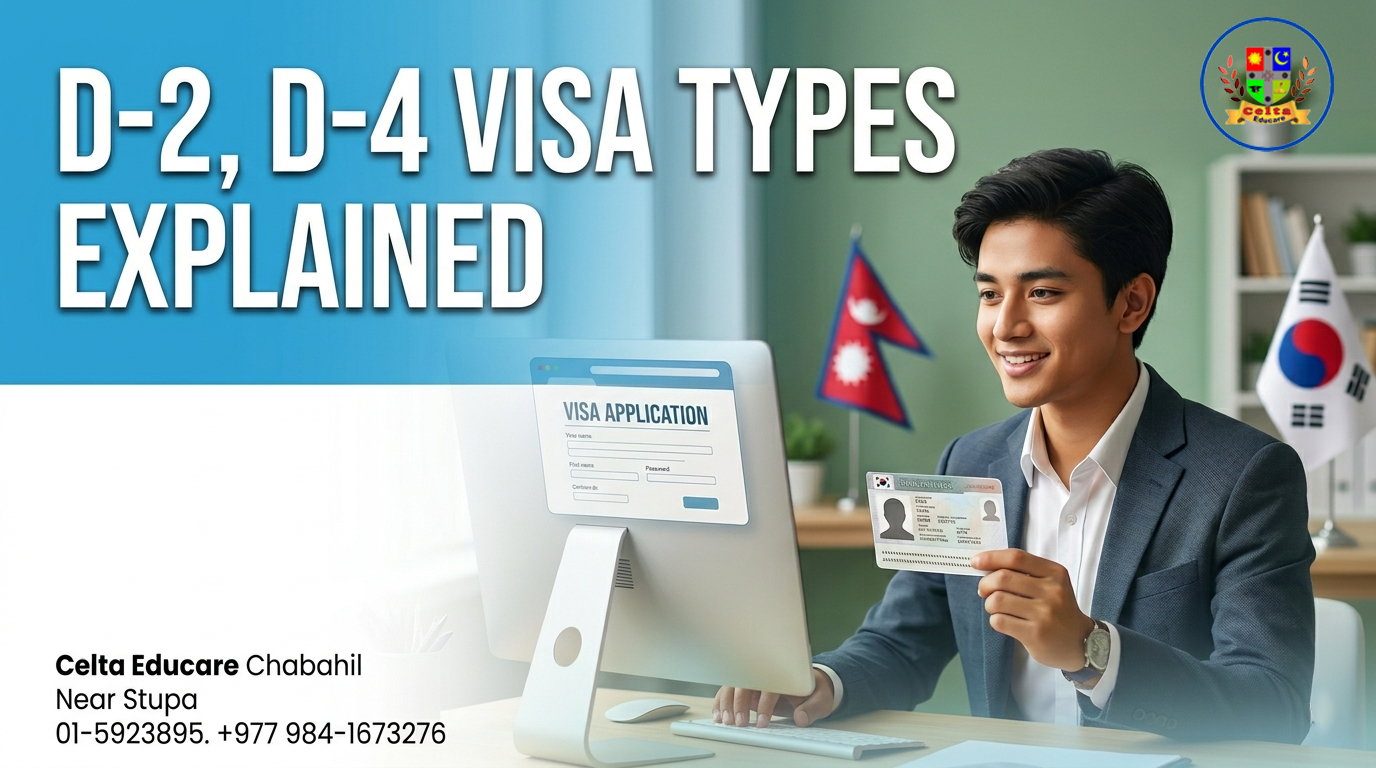
Understanding Korean Student Visa Types: D-2 vs D-4
To begin with, Korea has two main student visa categories for Nepali applicants. Understanding the difference is crucial because, ultimately, applying for the wrong one can lead to delays or even outright rejection.
D-2 Visa: Regular Student Visa
The D-2 visa is designed specifically for students who have already been admitted to a Korean university or college. In other words, it covers formal degree programs — including bachelor’s, master’s, and doctoral degrees.
Who needs the D-2 visa?
- Students enrolling in a 4-year undergraduate program
- Students pursuing a Master’s or PhD at a Korean university
- Students enrolled in an associate degree (2-year college) program
- Research students attached to a Korean institution
Key features of the D-2 visa:
- Valid for the full duration of your academic program (usually 1–2 years, and renewable)
- Allows part-time work up to 20 hours per week during semesters, and unlimited hours during vacations
- Can be extended within Korea — meaning you don’t need to return to Nepal to renew it
- In some cases, also allows you to bring dependents after completing one year of study
D-4 Visa: General Training Visa
The D-4 visa, on the other hand, is for students attending language institutes, vocational training schools, or preparatory programs. In fact, most Nepali students begin their Korean journey with the D-4 visa by enrolling in a Korean language program before later transitioning to a full university degree.
Who needs the D-4 visa?
- Students attending a Korean language institute (어학당) at a university
- Students enrolled in vocational or skills training programs
- Students in preparatory courses before entering a university degree program
Key features of the D-4 visa:
- Usually valid for 6 months to 1 year, and fully renewable
- Can be converted to a D-2 visa once you secure university admission
- Part-time work is allowed — up to 20 hours per week with a valid work permit
- An excellent starting point, particularly if your Korean language skills still need improvement
D-2 vs D-4: A Quick Comparison
| Feature | D-2 Visa | D-4 Visa |
|---|---|---|
| Purpose | University degree program | Language/vocational training |
| Duration | 1–2 years (renewable) | 6 months–1 year (renewable) |
| Work allowed | Up to 20 hrs/week | Up to 20 hrs/week (with permit) |
| Conversion | Not needed | Can convert to D-2 |
| University admission required | Yes | No |
As you can see from the table above, your choice between D-2 and D-4 depends entirely on your current admission status and language readiness. So, before applying, always confirm which category fits your specific situation.
Step-by-Step: How to Apply for a Korean Student Visa from Nepal
Now that you understand the visa types, let’s walk through the complete application process from start to finish.
Step 1: Get Admitted to a Korean Institution
First and foremost, you need to secure your institutional placement. For a D-2 visa, specifically, you’ll need an official admission letter from a Korean university. For a D-4 visa, meanwhile, you need an enrollment confirmation from a language school or training institute.
To begin, research Korean universities and apply directly through their international admissions offices. Many universities offer English-language programs. However, some programs require TOPIK scores for Korean-medium courses, so check those requirements early and plan accordingly.
Step 2: Gather Your Required Documents
This is where most students feel overwhelmed — but in reality, it’s quite manageable once you know exactly what’s needed.
Common documents required for both D-2 and D-4 applications:
- Valid passport (with at least 6 months of validity remaining)
- Completed visa application form (available directly from the Korean Embassy website)
- Recent passport-size photos (white background, taken within the last 6 months)
- Admission letter or enrollment confirmation from your Korean institution
- Certificate of Admission (입학허가서) issued by the institution
- Financial proof — typically bank statements showing at least USD 7,000–10,000 equivalent
- Bank guarantee or sponsorship letter if a parent or guardian is funding your education
- Academic transcripts and certificates (SLC, +2, and bachelor’s degree if applicable)
- Personal statement or study plan explaining why you want to study in Korea
- Medical certificate (required by some programs)
- Proof of tuition fee deposit payment (if required by your institution)
Additionally, D-4 applicants need:
- Enrollment confirmation from the Korean language institute
- Proof of Korean language training registration
Step 3: Prepare Your Financial Documents Carefully
Financial documentation is, without question, one of the most critical parts of the Korean visa application. As such, the Korean Embassy carefully reviews your financial profile to confirm you can comfortably support yourself throughout your studies.
Here’s what makes a genuinely strong financial package:
- Bank statements that cover the last 3–6 months consistently
- A balance that remains stable — because sudden large deposits are a major red flag for embassy officers
- A notarized sponsorship affidavit from a parent or guardian if they are covering your expenses
- Property or asset documents where needed to further demonstrate overall financial capacity
Unfortunately, many visa rejections happen precisely because of weak or inconsistent financial documents. That is exactly why working with Celta Educare Chabahil’s experienced counselors can save you from these costly and time-wasting mistakes.
Step 4: Submit Your Application at the Korean Embassy
The Korean Embassy in Nepal is located in Maharajgunj, Kathmandu. Therefore, you will need to visit in person to submit your complete application package.
Follow these steps at the embassy:
- First, book an appointment through the official Korean Embassy Nepal website
- Next, submit your entire document package in the correct order
- Then, pay the visa fee (approximately USD 60 for most student visa categories)
- After that, attend an interview if the embassy requests one — though this is not always required
- Finally, wait for processing, which typically takes 5–10 working days
Pro tip: Always double-check every single document before submission. Even one missing paper can, as a result, delay your entire application significantly.
Step 5: Receive Your Visa and Prepare for Departure
Once your visa is approved, you’ll receive your passport back with the Korean student visa stamped inside. Before departing Nepal, however, make sure to complete a few important tasks:
- Book your flight and arrange accommodation in advance (many universities offer affordable dormitories)
- Set up your mandatory health insurance, which is required by Korean law
- Attend a pre-departure orientation — Celta Educare Chabahil provides these highly helpful sessions
- Also, learn some basic Korean phrases, because even a few words go a long way in daily life
Student Life in Korea: What to Expect After You Arrive
Once you land, student life in Korea quickly reveals itself to be dynamic, safe, and genuinely full of opportunities. Here’s a real picture of what daily life looks like.
Campus Life and Academic Culture
Korean universities are modern, beautifully equipped, and deeply internationally connected. Generally, most large institutions have dedicated international student offices that assist with everything from settling in to navigating paperwork and bureaucracy. Furthermore, the academic culture, while serious, is also highly supportive — professors are generally accessible, campus libraries stay open 24/7, and study cafes exist on nearly every street.
Cost of Living
Compared to Western countries, student life in Korea is surprisingly affordable. Here’s a realistic monthly cost estimate:
- Accommodation: 200,000–500,000 KRW (university dormitories are considerably cheaper)
- Food: 300,000–400,000 KRW
- Transportation: 50,000–80,000 KRW
- Miscellaneous: 100,000–200,000 KRW
- Total monthly estimate: approximately 650,000–1,200,000 KRW (roughly USD 500–900)
As a result, many Nepali students find that Korea’s cost of living is quite comparable to, or even lower than, what they would spend at home on an international-standard lifestyle.
Part-Time Work
One of the most practical advantages of student life in Korea is, of course, the legal ability to work part-time. Specifically, with a valid Alien Registration Card (ARC) and an approved work permit, you can take jobs at restaurants, convenience stores, tutoring centers, or even pursue online freelance work. Not only does this help cover day-to-day living expenses, but it also gives you invaluable international work experience to add to your resume.
Korean Language Learning
Even if your degree program is entirely in English, learning Korean will enrich your student life in Korea enormously. Fortunately, most universities offer free or heavily subsidized Korean language classes for international students. Additionally, TOPIK preparation materials, language exchange partner programs, and apps like Duolingo all make the learning process highly accessible, even for complete beginners.
Common Reasons for Korean Student Visa Rejection (and How to Avoid Them)
Understanding why visa applications fail is just as important as knowing what to include. Here are the most common rejection reasons — and, more importantly, how to avoid each one:
- Insufficient or inconsistent financial documents — sudden last-minute bank deposits are immediate red flags for embassy officers
- Incomplete application form — even small errors like missing signatures or incorrect dates can trigger rejection
- Unclear or vague study plan — a weak personal statement raises serious doubts about your genuine intent to study
- Poor academic history — extremely low grades, especially without any explanation, create concern among officers
- Previous visa violations — overstaying a visa in any country is a serious issue that affects your overall credibility
- Unreliable institution — applying to a Korean institution that isn’t officially recognized by the Korean government will result in automatic rejection
Fortunately, all of these issues are completely avoidable with the right preparation. Working with a reputable consultancy like Celta Educare Chabahil ensures that your application is thorough, consistent, and professionally prepared — addressing every one of these potential pitfalls well before submission.
FAQ: Korea Student Visa from Nepal
1. How long does the Korean student visa process take from Nepal?
Processing generally takes 5–10 working days from the date of submission. However, if you’re applying during peak season — typically March or September intake — it may take a bit longer. Therefore, it’s strongly advisable to apply at least 6–8 weeks before your intended program start date.
2. Can I work while studying in Korea on a D-4 visa?
Yes, you absolutely can — but you will need a separate work permit first. D-4 visa holders can legally work up to 20 hours per week once they obtain a valid permit. To get it, simply apply through the Korea Immigration Service after arriving and completing your ARC registration.
3. How much money do I need to show for a Korean student visa?
Most applicants need to demonstrate financial capacity of at least USD 7,000–10,000 (or the Korean won equivalent). Furthermore, the exact amount can vary depending on your program length and institution. Above all, your bank balance must remain stable over at least the past 3–6 months.
4. Can I switch from a D-4 to a D-2 visa while already in Korea?
Absolutely — and in fact, this is one of the most common pathways that Nepali students follow. After successfully completing your language program and receiving university admission, you can apply for a D-2 visa status change directly at your local immigration office, without needing to return to Nepal at all.
5. Is TOPIK required for a Korean student visa?
Not necessarily for the visa application itself. Nevertheless, many Korean universities do require TOPIK scores for admission to Korean-language degree programs. For English-medium programs, on the other hand, IELTS or TOEFL scores are typically required instead. Consequently, always check the specific admission requirements of your target university well in advance.
6. What scholarships are available for Nepali students in Korea?
Notably, several excellent scholarship options are open to Nepali students. These include the Korean Government Scholarship Program (GKS/KGSP), various university-specific merit scholarships, and KOICA development programs. In addition, a knowledgeable consultancy like Celta Educare can help you identify the right scholarship and guide you through the application process effectively.
7. What happens if my visa is rejected?
First of all, don’t panic — rejection is not the end of the road. You can reapply after carefully addressing the stated reasons for rejection. The embassy usually provides a rejection reason, which, as a result, gives you a clear starting point for improvement. Subsequently, a consultancy like Celta Educare can review your previous application, strengthen the weak areas, and guide you toward a successful resubmission.
8. Is student life in Korea safe for Nepali students?
Yes, absolutely — Korea is consistently ranked as one of the safest countries in Asia. Crime rates are low, cities are clean and well-organized, and there is a growing, welcoming Nepali community across major Korean cities — especially in Seoul and Busan. Moreover, you’ll find Nepali restaurants, active community groups, and regular cultural events that genuinely help ease any feelings of homesickness.
Conclusion: Your Korean Dream Is Well Within Reach
In summary, student life in Korea offers something truly special — a powerful blend of world-class education, personal growth, cultural immersion, and career opportunities that are hard to match anywhere else in Asia. As a Nepali student, you are therefore in a strong position to take full advantage of Korea’s growing openness to international talent.
The visa process may seem complex at first glance. However, with the right preparation and proper documentation, it becomes completely manageable. Start by confirming which visa type fits your current situation — D-2 for direct university enrollment, or D-4 for language and preparatory programs. Then, gather your documents carefully, prepare solid financial proof, and submit your application well in advance.
Most importantly, you don’t have to navigate this process alone. Indeed, Celta Educare Chabahil Consultancy brings the expertise, experience, and personal attention that genuinely makes a difference in application outcomes. Therefore, whether you’re just beginning to explore your options or already have a university in mind, visiting their Chabahil office or connecting with them online is the smartest step you can take right now.
Your future in Korea is waiting — so take the first step today.
Recent Post
- Hidden Expenses of Studying in Japan That Students Often Ignore
- Japan Student Visa Rejection Reasons and How to Avoid Them
- Daily Life of International Students in Korea
- Complete Guide to Korea Student Visa Process from Nepal: D-2, D-4 Visa Types Explained
- Study in Korea Without IELTS: Is It Possible? A Complete Guide for International Students