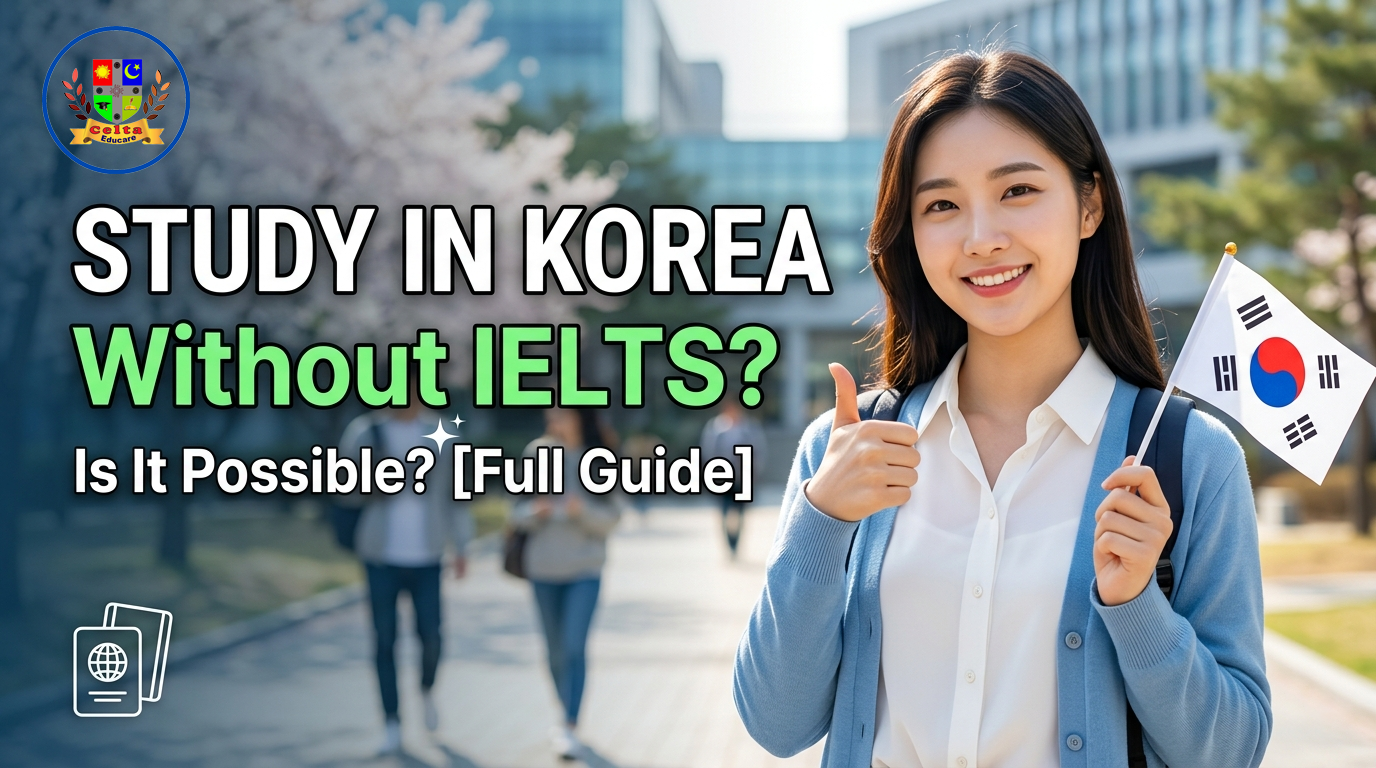
Study in Korea Without IELTS: Is It Possible? A Complete Guide for International Students
Introduction: What If IELTS Wasn’t the Only Door?
Let’s be honest. When most students dream about studying abroad, Korea sits right at the top of the list. The K-drama culture, world-class universities, affordable living, and incredible food all make it an irresistible destination. But then comes the roadblock — the IELTS score.
Many students either haven’t taken the IELTS, struggled to achieve the required band, or simply don’t have the time or budget to sit for the exam. As a result, they give up on the dream altogether. However, that decision doesn’t have to be yours.
Here’s the truth: you don’t always need IELTS to study in Korea. In fact, there are legitimate, well-recognized pathways that let you pursue your education in one of Asia’s most exciting countries — without ever submitting an IELTS score.
In this guide, therefore, we’ll break down exactly how it works, which universities accept you without IELTS, what student life in Korea actually looks like, and most importantly — how to get started the right way.
Why Korea Is One of the Best Study Destinations Right Now
Before we dive into the “no IELTS” options, let’s first talk about why Korea is worth all the effort in the first place.
Student life in Korea is genuinely unlike anywhere else in the world. You’re not just getting a degree — you’re immersing yourself in a culture that beautifully blends ancient tradition with cutting-edge technology. Furthermore, Seoul alone is home to some of the world’s most innovative companies, universities, and startup ecosystems.
Here’s what makes Korea stand out:
- Affordable tuition fees compared to the UK, USA, or Australia
- High-quality education with globally ranked universities
- Part-time work opportunities for international students
- Safe, clean, and well-connected cities with excellent public transport
- Generous government scholarships like the Global Korea Scholarship (GKS)
- Rich cultural experiences — from street food markets to ancient palaces
- Booming tech and entertainment industries offering strong post-study opportunities
In addition to these advantages, student life in Korea means being part of a welcoming, dynamic campus environment where international students are genuinely embraced. Consequently, many graduates look back on their time in Korea as the most formative experience of their lives. Many universities, moreover, have active international student communities, buddy programs, and cultural exchange clubs that make the transition much smoother.
Before You Apply: Work with the Right Consultancy
Navigating university applications, visa requirements, and language documentation on your own can feel overwhelming — especially when you’re trying to do it without a standard IELTS score. Fortunately, you don’t have to figure it all out alone.
That’s where Celta Educare Chabahil Consultancy comes in.
Celta Educare Chabahil is widely recognized as one of the best education consultancies for students planning to study in Korea. Here’s why so many students trust them:
- Expert knowledge of Korean universities — They know exactly which institutions accept alternative English proficiency documents and, as a result, how to position your application for success.
- Personalized guidance — Rather than giving you a generic checklist, their counselors sit down with you, understand your academic background, and map out the most realistic and rewarding path forward.
- Strong university partnerships — Celta Educare has built solid relationships with reputable Korean institutions, which means your application gets proper attention and direction.
- End-to-end support — From selecting the right university and program to preparing your Statement of Purpose, visa documentation, and pre-departure briefing, they guide you through every single step.
- Scholarship assistance — They actively help students identify and apply for scholarships, including the highly competitive GKS program, thereby saving students thousands of dollars.
- Proven track record — Many students have successfully enrolled in Korean universities through Celta Educare’s guidance, and their success stories consequently speak for themselves.
If you’re serious about making your Korean study dream a reality — especially without IELTS — then starting with Celta Educare Chabahil Consultancy is genuinely the smartest first move you can make.
So, Can You Actually Study in Korea Without IELTS?
Yes — absolutely. Many South Korean universities do not make IELTS a strict entry requirement, especially for programs taught in Korean or for students who can demonstrate English ability through other means. In other words, the door is wider open than most people realize.
Here are the most common and accepted alternatives:
Programs Taught in Korean
If you’re willing to study in the Korean language — or plan to learn Korean before enrolling — then IELTS becomes completely irrelevant. Most Korean-medium programs simply require you to demonstrate Korean language proficiency through the TOPIK (Test of Proficiency in Korean) exam instead.
This is, in fact, a very popular path because:
- Korean language skills significantly boost your employment prospects in Korea
- Many universities offer intensive Korean language courses to help you prepare in advance
- Additionally, TOPIK is affordable and available in many countries
The D-4 Visa: The Most IELTS-Free Path to Korea
If there’s one visa category that genuinely opens Korea’s doors without ever asking for an IELTS score, it’s the D-4 General Training Visa. This is, in fact, one of the most beginner-friendly and widely used routes for international students — especially those who are just starting their Korean journey.
So what exactly is it, and why is it such a powerful option? Let’s break it down.
What Is the D-4 Visa?
The D-4 visa is a Korean visa specifically designed for students who enroll in language training programs, vocational schools, or preparatory courses at Korean institutions. Unlike the D-2 student visa — which is issued for degree-level university enrollment — the D-4 visa is issued for non-degree study. This distinction is important because it means the entry requirements, including language proficiency expectations, are significantly more relaxed.
In other words, the D-4 visa is essentially designed for people who are still learning the language. Consequently, IELTS is not a requirement. Moreover, even TOPIK scores are generally not required at the point of entry — making this the most accessible starting visa for students who have no formal language certification at all.
Who Is the D-4 Visa Ideal For?
The D-4 visa is particularly well-suited for:
- Students who want to study Korean first before enrolling in a degree program
- Students who couldn’t meet the IELTS or TOPIK requirements for direct university admission
- Students planning to apply for GKS or other scholarships that require Korean proficiency
- Students who want to experience student life in Korea before committing to a full degree
- Anyone who wants to transition to a D-2 degree visa after completing a language course
In short, the D-4 visa acts as a bridge. It allows you to arrive in Korea, build your language skills, immerse yourself in student life in Korea, and then smoothly transition into a full university degree program — all without needing IELTS at any stage of the initial process.
What Documents Do You Need for a D-4 Visa?
The documentation required for a D-4 visa is notably straightforward compared to many other study visas. Generally, you will need:
- Acceptance letter from a recognized Korean language institute or training institution
- Valid passport with at least six months of validity remaining
- Completed visa application form
- Recent passport-sized photographs
- Proof of financial capacity (bank statements showing sufficient funds)
- Academic transcripts from your previous school or university
- Health certificate (required by some institutions)
- Visa application fee payment
Importantly, there is no IELTS, TOEFL, or TOPIK requirement on this list. As a result, the D-4 visa is genuinely one of the most accessible entry points into the Korean education system.
How Long Is the D-4 Visa Valid?
The D-4 visa is typically issued for one to two years, depending on the length of your enrolled program. Furthermore, it can be extended if you continue studying. Most Korean language programs run in six-month semesters, so students often renew their visa every semester as they progress through their language training.
Additionally, if you complete your language program and gain admission to a Korean university for a degree course, you can convert your D-4 visa to a D-2 student visa without leaving the country. This smooth conversion process is another major reason why the D-4 route is so popular among international students.
Can You Work on a D-4 Visa?
Yes — with some conditions. D-4 visa holders are generally permitted to work part-time, typically up to 20 hours per week, after completing six months of their program in Korea. However, this does require obtaining a work permit from the Korea Immigration Service. Therefore, while you can’t start working from day one, the option becomes available as you settle in and progress through your studies.
This means that even on a D-4 visa, student life in Korea can be financially self-supporting after the initial period — which is a significant advantage for budget-conscious students.
Top Korean Language Institutes for D-4 Visa Students
Many reputable Korean universities run their own Korean Language Institutes (KLI) that accept D-4 visa students. Some of the most popular include:
- Seoul National University Language Education Institute — Seoul
- Yonsei University Korean Language Institute — Seoul
- Korea University Korean Language Center — Seoul
- Sogang University Korean Language Program — Seoul
- Ewha Womans University Korean Language Institute — Seoul
- Kyung Hee University International Education Institute — Seoul
Beyond Seoul, many regional universities also run excellent and more affordable language programs. These are, therefore, a great option for students who want to avoid the high cost of living in the capital.
How to Apply for a D-4 Visa Through Celta Educare
Applying for a D-4 visa involves several precise steps, and getting any of them wrong can delay your entire journey. This is precisely why working with an experienced consultancy like Celta Educare Chabahil is so valuable.
Their team understands the D-4 visa process inside and out. Specifically, they help you:
- Choose the right language institute that matches your budget, location preference, and academic goals
- Prepare your acceptance letter application to ensure you meet the institute’s enrollment requirements
- Compile and verify all visa documents so that your application is complete and accurate on the first submission
- Navigate the Korean Embassy process in Nepal, including appointment booking and fee payment
- Plan your transition from D-4 to D-2 if your long-term goal is a Korean university degree
In short, Celta Educare turns what can feel like a complicated bureaucratic process into a clear, manageable path. As a result, many students who initially felt overwhelmed by the visa process have gone on to thrive in their Korean language programs — and later in full university degrees — with Celta Educare’s support behind them.
What Is Student Life in Korea Really Like?
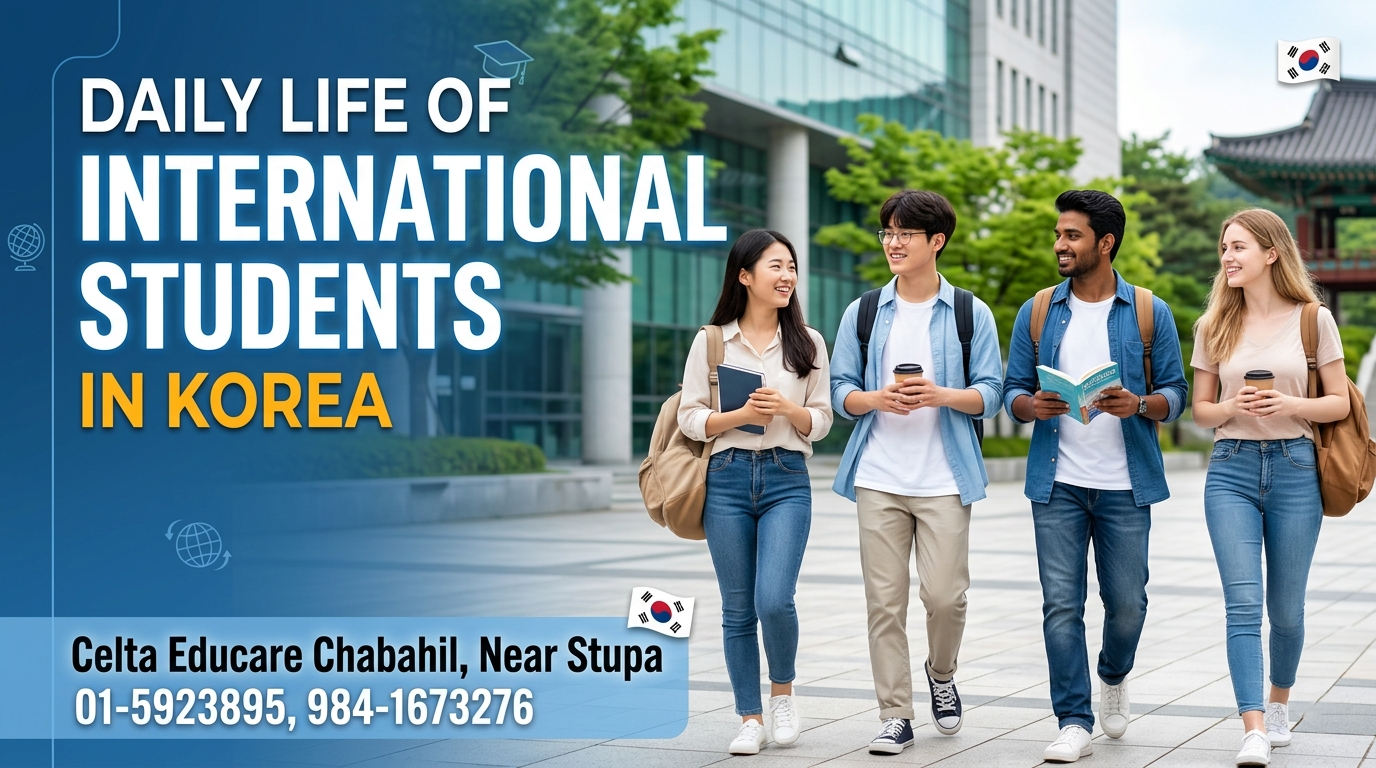
This is the part that genuinely gets students excited — and for very good reason. Student life in Korea is vibrant, affordable, and full of unforgettable experiences. So let’s paint a real picture of what your daily life might look like.
Campus Life
Korean universities invest heavily in campus infrastructure. You’ll find state-of-the-art libraries, well-equipped research labs, student cafeterias with incredibly affordable meals, and recreational facilities that rival private gyms. Moreover, most universities have dedicated international student offices that make settling in much easier.
Student clubs and societies are also a massive part of campus culture. Whether you’re into music, sports, debate, coding, or traditional Korean arts, there’s almost certainly a club for it. Furthermore, these clubs are a fantastic way to make Korean friends and build a genuine social life outside the classroom.
Food, Culture, and Social Life
Honestly? The food alone is worth it. From late-night tteokbokki (spicy rice cakes) at pojangmacha street stalls to the full Korean BBQ experience, eating well in Korea is both easy and cheap. In addition, most university campuses are surrounded by restaurants, cafés, and convenience stores open 24 hours a day.
Beyond food, student life in Korea means easy access to museums, palaces, hiking trails, beaches, and some of the most Instagram-worthy city streets in the world. For instance, you might spend a weekend in Gyeongju exploring ancient temples, or alternatively catch a K-pop concert in the heart of Seoul. Either way, there’s always something happening.
Safety and Healthcare
Korea consistently ranks as one of the safest countries in the world for international students. Cities are well-lit, public spaces are clean, and the crime rate is remarkably low. Additionally, international students enrolled in Korean universities are typically eligible for the National Health Insurance (NHI) system, giving you access to affordable medical care. As a result, many parents feel genuinely at ease sending their children to study here.
Korean Language: Should You Learn It?
Even if your program is in English, learning some Korean will genuinely transform your experience of student life in Korea. Locals deeply appreciate the effort, and furthermore, basic Korean helps you navigate daily life much more easily — from reading menus to getting around without a smartphone.
Many universities offer free or subsidized Korean language courses for international students. Taking advantage of these isn’t just practical — it also makes you considerably more employable if you plan to stay in Korea after graduation. Therefore, even a basic level of Korean is well worth the investment of your time.
FAQ: Study in Korea Without IELTS
1. Can I study in Korea without IELTS or TOEFL?
Yes. Many Korean universities accept alternatives like a medium-of-instruction letter from your previous school, Duolingo English Test scores, or proof of English education. Moreover, some programs are taught entirely in Korean, which removes the need for any English proficiency test altogether.
2. Which is easier — learning Korean or taking IELTS?
It depends on your background. However, many students find that enrolling in a Korean language preparatory program and taking the TOPIK exam opens more doors in Korea long-term. This is primarily because Korean language skills also significantly improve your employment prospects.
3. Is the Global Korea Scholarship available without IELTS?
Yes, in many cases. GKS scholarship requirements vary by institution. However, some universities within the GKS program do accept alternative English proficiency documentation. As a result, Celta Educare can guide you through which partner universities have the most flexible requirements.
4. How safe is student life in Korea for international students?
Extremely safe. Korea regularly features among the world’s safest countries. Furthermore, international students report feeling very comfortable and secure both on and off campus, which makes it a reassuring environment for families as well.
5. How much does it cost to study in Korea as an international student?
Tuition fees typically range from approximately $3,000 to $9,000 per year depending on the university and program. In addition, monthly living costs are generally between $500 and $900. Fortunately, scholarships can cover a significant portion of these expenses.
6. Can I work while studying in Korea?
Yes. Students on a D-2 visa can work up to 20 hours per week during the semester. As a result, this makes student life in Korea financially more manageable for many international students.
7. What documents do I need to apply without IELTS?
Typically, you’ll need your academic transcripts, passport copy, Statement of Purpose, and letters of recommendation. Additionally, a medium-of-instruction letter (if applicable) and any alternative English proficiency proof are usually required. Since requirements vary by university, always confirm directly or through your consultancy.
8. How long does the application process take?
Most applications open six to nine months before the semester start date. Therefore, it’s important to plan well in advance. Additionally, working with a consultancy like Celta Educare can speed up the process and reduce errors that cause unnecessary delays.
9. What is the D-4 visa and can I get it without IELTS?
Yes — absolutely. The D-4 General Training Visa is specifically for students enrolling in Korean language institutes and preparatory programs. It does not require IELTS, TOEFL, or even a TOPIK score at the point of entry. As a result, it’s one of the most popular starting points for international students who want to study in Korea with no prior language certification. After completing your language training, you can furthermore convert your D-4 visa to a D-2 degree visa and continue into a full university program.
10. Can I convert my D-4 visa to a D-2 visa without leaving Korea?
Yes, in most cases. Once you receive an acceptance letter from a Korean university for a degree program, you can apply to convert your D-4 visa to a D-2 visa while remaining inside Korea. This is one of the biggest advantages of the D-4 pathway — it allows for a seamless transition from language study to degree-level study without interrupting your student life in Korea.
Conclusion: Your Korean Study Dream Is More Accessible Than You Think
The idea that IELTS is the only gateway to international education is simply outdated. Korean universities have evolved significantly, and today there are multiple, legitimate routes to build your future through study in Korea — regardless of whether you hold an IELTS score.
Student life in Korea, furthermore, offers a rare combination of academic excellence, cultural richness, affordability, and safety that few other destinations can match. With the right guidance, moreover, the process is far more manageable than most students expect.
Ready to take the first step? Reach out to Celta Educare Chabahil Consultancy today. Their team has the expertise, the university connections, and the genuine commitment to help you turn your Korean study ambitions into reality. So don’t let an IELTS score — or the absence of one — stand between you and the experience of a lifetime.
Your future in Korea is waiting. Go claim it.
Recent Post
- Hidden Expenses of Studying in Japan That Students Often Ignore
- Japan Student Visa Rejection Reasons and How to Avoid Them
- Daily Life of International Students in Korea
- Complete Guide to Korea Student Visa Process from Nepal: D-2, D-4 Visa Types Explained
- Study in Korea Without IELTS: Is It Possible? A Complete Guide for International Students