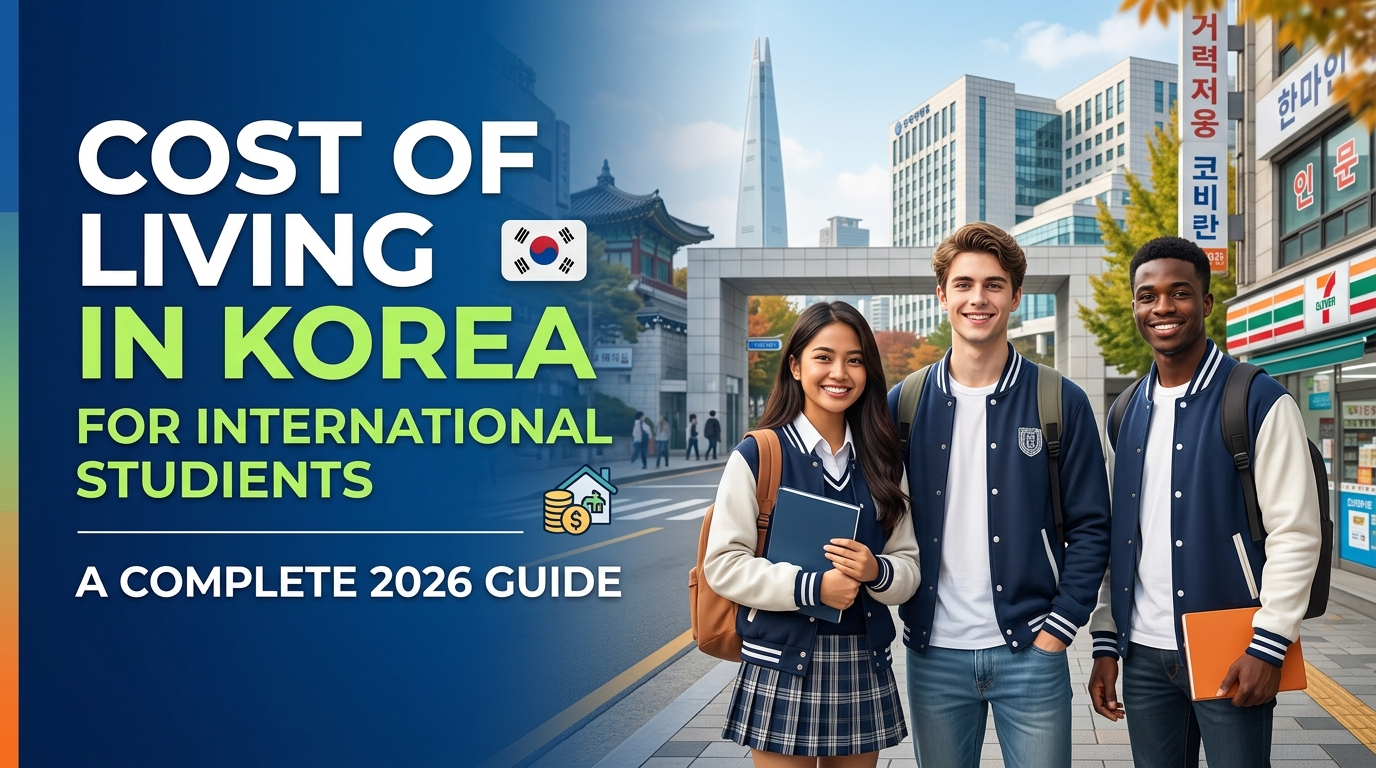
Cost of Living in Korea for International Students: A Complete 2026 Guide
Introduction: Is Korea Really Affordable for International Students?
Picture this: You’re walking through a vibrant university campus in Seoul, grabbing a warm bowl of tteokbokki for less than $3 (NRS 400), and heading to your cozy dorm room with blazing-fast internet — all while studying at one of Asia’s top universities. Sounds like a dream, right?
Well, for thousands of international students every year, this is simply everyday life in South Korea.
But before you start packing your bags, there’s one big question every student (and their parents) wants answered: How much does it actually cost to live in Korea as an international student?
The honest answer? Korea is genuinely one of the most student-friendly countries in Asia when it comes to cost of living — especially if you plan smartly. However, costs can vary significantly depending on your city, lifestyle, and university. That’s why having proper guidance before you apply is not just helpful — it’s essential.
This is exactly where Celta Educare Chabahil Consultancy stands out as the best choice for students considering Korea. Based in the heart of Kathmandu, Celta Educare has built a solid reputation for providing honest, detailed, and personalized guidance to Nepali and South Asian students looking to study abroad. Furthermore, their team has first-hand knowledge of Korean universities, scholarship options, and living costs — so you don’t walk into Korea blindly. As a result, they help students choose the right city, the right university, and the right budget plan from day one. Indeed, hundreds of students have already trusted Celta Educare’s transparent and supportive approach, and their success stories speak louder than any brochure.
Now, let’s break down exactly what student life in Korea costs — month by month.
What Is the Average Monthly Cost of Living in Korea for International Students?
To begin with, the average monthly expenses for an international student in South Korea typically range between ₩600,000 to ₩1,200,000 KRW (approximately $450 to $900 USD / NRS 60,000 to NRS 1,20,000), depending on your location and lifestyle.
Here’s a quick snapshot:
| Expense Category | Monthly Cost (Approx.) |
|---|---|
| Accommodation | ₩200,000 – ₩500,000 |
| Food & Groceries | ₩150,000 – ₩300,000 |
| Transportation | ₩50,000 – ₩100,000 |
| Utilities | ₩50,000 – ₩100,000 |
| Mobile & Internet | ₩30,000 – ₩60,000 |
| Personal & Leisure | ₩50,000 – ₩150,000 |
| Total Estimate | ₩530,000 – ₩1,210,000 |
As a result, these numbers make Korea significantly more affordable than countries like the USA, UK, or Australia — which is one of the biggest reasons student life in Korea is so attractive globally.
Accommodation Costs in Korea: Where Will You Live?
Housing is usually your biggest monthly expense. Therefore, let’s look at all your realistic options carefully.
University Dormitories
Most Korean universities offer on-campus dormitories for international students, and they’re genuinely great value. Specifically, a dorm room typically costs between ₩200,000 to ₩400,000 per month, often including utilities, Wi-Fi, and sometimes even meals.
Moreover, competition for dorm spots can be high at top universities, so applying early is very important. In particular, universities like Seoul National University, Yonsei, Korea University, and KAIST all offer well-maintained international dorms.
Gosiwon (고시원)
In contrast to dorms, a gosiwon is a small, private room commonly used by students and young workers. Nevertheless, these micro-rooms are extremely affordable — often ₩200,000 to ₩350,000 per month — and typically include Wi-Fi, basic utilities, and sometimes a shared kitchen. They’re not spacious, but they’re clean, safe, and perfectly functional for a budget-conscious student.
One-Room Officetel or Studio Apartment
On the other hand, if you want more privacy and space, renting a small one-room apartment (called an “officetel”) typically costs ₩400,000 to ₩700,000 per month in mid-sized cities, and even higher in central Seoul. Additionally, you’ll need to pay a “key money” deposit (called jeonse or wolse), which varies by location.
Shared Housing
Meanwhile, sharing an apartment with fellow students is another popular and cost-effective option. For instance, splitting rent for a two or three-bedroom apartment can bring your monthly housing cost down to around ₩250,000 to ₩400,000 per person.
Pro Tip: Furthermore, living slightly outside major city centers (but near subway stations) can cut your rent costs by 30–40% while still keeping you well-connected.
Food Costs: Eating Well Without Breaking the Bank
Here’s some genuinely great news — Korea is a paradise for affordable, delicious food. In fact, student life in Korea is closely tied to the joy of eating, and you certainly don’t need to spend a fortune to eat well.
University Cafeterias (학식 – Haksik)
First of all, Korean university cafeterias are legendary among students. You can get a full, balanced hot meal — rice, soup, side dishes, and a main course — for just ₩3,000 to ₩5,000 (about $2–$4 / NRS 270–540). In addition, these cafeterias are heavily subsidized and open for breakfast, lunch, and dinner at most universities.
Street Food and Local Restaurants
Beyond cafeterias, Korean street food is cheap, satisfying, and everywhere. For example, here’s what a typical food day might look like:
- Kimbap roll: ₩1,500 – ₩3,000
- Bowl of ramen or ramyeon: ₩3,000 – ₩5,000
- Bibimbap at a local restaurant: ₩7,000 – ₩10,000
- Coffee at a café: ₩3,000 – ₩5,000
Consequently, if you eat mostly local Korean food rather than Western or imported items, you can manage your food budget comfortably at ₩150,000 to ₩250,000 per month.
Cooking at Home
Alternatively, buying groceries from local markets like Emart, Homeplus, or traditional sijang (markets) lets you eat for even less. Notably, fresh vegetables, eggs, tofu, noodles, and rice are all very affordable in Korea.
Transportation: Getting Around Korea on a Student Budget
Korea’s public transportation system is world-class, and it’s also incredibly affordable — which is a major benefit of student life in Korea.
- Subway (metro): A single ride costs around ₩1,250 – ₩1,450 depending on distance
- City buses: Similarly priced to the subway; seamlessly connected across cities
- T-Money Card: A rechargeable transportation card that gives discounts when transferring between subway and bus — a must-have for students
- Monthly transportation estimate: As a result, most students spend between ₩50,000 to ₩100,000 per month on transport
Furthermore, if your university is in a smaller city like Daejeon, Daegu, Gwangju, or Busan, transportation costs can be even lower. In addition, cycling is also common near campuses.
Besides that, long-distance travel between cities via KTX (high-speed rail) or intercity buses is also reasonably priced, especially with student discounts.
Utilities, Internet, and Mobile Plans
Not only is Korea known for world-class education, but it also has some of the fastest internet in the world — and it’s surprisingly cheap.
- Monthly mobile plan: ₩30,000 – ₩60,000 for unlimited data (students often get plans as low as ₩20,000)
- Wi-Fi: Free in dorms, cafés, libraries, and most public places
- Electricity and gas: ₩30,000 – ₩80,000 per month depending on season (winter heating can push this higher)
- Water: Usually included in rent or costs under ₩10,000 monthly
Importantly, if you live in a dorm, most utilities are bundled into your accommodation cost, which simplifies budgeting considerably.
Education-Related Costs: Tuition and Study Fees
Of course, tuition is a key part of your overall budget. Tuition at Korean universities varies by institution and program type:
- Public universities: ₩2,000,000 – ₩5,000,000 per semester (about $1,500 – $3,800 USD / NRS 2,00,000 – NRS 5,10,000)
- Private universities: ₩3,500,000 – ₩8,000,000 per semester (about $2,600 – $6,000 USD / NRS 3,50,000 – NRS 8,00,000)
- Graduate programs: Often covered by research stipends or scholarships
Fortunately, Korea offers some of the most generous scholarship programs in Asia for international students, including the prestigious GKS (Global Korea Scholarship) and numerous university-funded scholarships. As a result, many students end up paying little to no tuition at all.
Moreover, Celta Educare Chabahil Consultancy helps students navigate these scholarship applications — which can feel overwhelming — by guiding them through eligibility criteria, documentation, and deadlines. Therefore, their support in this area alone can save students millions of rupees.
Part-Time Work Opportunities for International Students
Beyond scholarships, student life in Korea often includes working part-time, which is completely legal for international students on a D-2 visa (up to 20 hours per week during the semester, and full-time during breaks).
Common part-time jobs for international students include:
- English tutoring or language exchange partnerships
- Part-time work at convenience stores, cafés, or restaurants
- Campus jobs (library, research assistant, etc.)
- Freelancing or online work in your field
Notably, the minimum wage in Korea is approximately ₩10,030 per hour (about $7.60 USD / NRS 1,010) as of 2026, so even working 15–20 hours a week can meaningfully supplement your living costs. In addition, many students find that part-time work not only helps financially but also accelerates their Korean language skills.
Hidden Costs to Budget For
Even with careful planning, many students forget to account for these less obvious expenses. Therefore, it’s wise to factor them in from the start:
- Health insurance: Mandatory for students in Korea, but usually affordable at around ₩40,000 – ₩70,000 per month through the National Health Insurance Service (NHIS)
- Books and supplies: ₩50,000 – ₩150,000 per semester depending on your program
- Initial setup costs: Bedding, kitchen supplies, and basic furniture when moving into a new place (can be ₩100,000 – ₩300,000 as a one-time expense)
- Travel and entertainment: Exploring Korea’s temples, mountains, beaches, and vibrant city life costs money — so budget for it and enjoy it!
Best Cities for International Students in Korea (By Cost)
Not all cities in Korea are equal in terms of cost of living. So, here’s a quick comparison to help you decide:
Seoul
Korea’s capital is the most expensive city. However, it also offers the most universities, networking opportunities, and career prospects. As a result, monthly living costs range from ₩800,000 to ₩1,200,000.
Busan
In comparison, Korea’s second city has lower rents, beautiful coastal scenery, and a growing international student community. Monthly costs typically range from ₩600,000 to ₩1,000,000.
Daejeon
Furthermore, home to KAIST and several other STEM-focused universities, Daejeon is notably affordable. Consequently, students here often manage on ₩500,000 to ₩800,000 per month.
Daegu and Gwangju
Similarly, both are mid-sized, affordable cities with strong university campuses and comfortable student life. Monthly budgets of ₩500,000 to ₩750,000 are very realistic here.
In summary, if your primary goal is to keep costs low while getting a quality Korean education, cities outside Seoul offer excellent value without sacrificing academic reputation.
Tips to Save Money While Studying in Korea
Smart budgeting can make your experience in Korea much more comfortable. Therefore, here are practical strategies that experienced students swear by:
- Use the T-Money card for all transportation to maximize transfer discounts
- Eat at the university cafeteria as much as possible — it’s both cheap and nutritious
- Buy seasonal produce from traditional markets rather than supermarkets
- Apply for university scholarships early — many are available specifically for international students
- Use KakaoTalk and data-inclusive plans instead of international calling
- Look for free cultural activities — in fact, many museums, parks, and events in Korea are free or discounted for students
- Find a Korean language exchange partner — not only does it improve your Korean, but it also builds friendships that can lead to cost-saving tips and opportunities
Why Celta Educare Chabahil Consultancy Is Your Best Partner for Studying in Korea
Planning to study in Korea involves a lot of moving parts — choosing the right university, gathering documents, applying for scholarships, securing a visa, and planning your finances. As a result, doing this alone is stressful and often leads to costly mistakes.
Fortunately, Celta Educare Chabahil Consultancy simplifies this entire journey. Here’s why students consistently choose them:
- Genuine expertise in Korean universities: Their counselors have up-to-date knowledge of admission requirements, course options, and scholarship deadlines at universities across Korea
- Scholarship guidance: Moreover, they help students identify and successfully apply for the GKS scholarship and other funding options that significantly reduce the financial burden
- Transparent cost planning: In addition, Celta Educare provides realistic, city-specific cost breakdowns so students arrive prepared — no nasty financial surprises
- End-to-end support: From selecting your course to visa application to pre-departure orientation, they are with you every step of the way
- Strong track record: As a result, their students have successfully enrolled in universities like Seoul National University, Hanyang, KAIST, Yonsei, and many others
- Community and trust: Above all, students and families trust Celta Educare because they prioritize long-term success over quick applications
Therefore, if you’re serious about making your Korean student journey smooth and successful, Celta Educare Chabahil Consultancy is the right place to start.
FAQ: Cost of Living in Korea for International Students
1. How much money do I need per month as an international student in Korea?
On average, you’ll need between ₩600,000 to ₩1,000,000 per month (about $450–$750 USD / NRS 60,000–NRS 1,00,000) for a comfortable student lifestyle, depending on your city and habits. For instance, Seoul costs more, while smaller cities like Daejeon or Daegu are notably more affordable.
2. Is Korea cheaper than other study-abroad destinations?
Yes, Korea is generally more affordable than the USA, UK, Australia, or Canada for international students. In particular, tuition, food, and public transportation are all significantly cheaper. Furthermore, combined with generous scholarship options, Korea offers excellent value for quality education.
3. Can I work while studying in Korea?
Absolutely. International students on a D-2 visa can work up to 20 hours per week during the semester and full-time during vacation periods. As a result, this can meaningfully offset your living costs.
4. What is the cheapest way to live in Korea as a student?
First and foremost, living in a university dormitory or a gosiwon keeps housing costs low. In addition, eating at university cafeterias, using public transportation with a T-Money card, and applying for scholarships are the most effective ways to minimize overall costs.
5. Are there scholarships available for international students in Korea?
Absolutely. The Korean government offers the Global Korea Scholarship (GKS), which covers tuition, dormitory housing, a monthly stipend, and airfare. Moreover, many universities also offer their own merit-based scholarships. Consequently, applying through an experienced consultancy like Celta Educare significantly improves your chances.
6. Is Korean food affordable for international students?
Yes, very much so. University cafeteria meals cost around ₩3,000 to ₩5,000, and street food is widely available at similar prices. Additionally, if you enjoy Korean cuisine (and most students quickly come to love it), you can eat well for under ₩200,000 per month.
7. How expensive is transportation in Korea?
Korea’s public transportation is among the most affordable and efficient in the world. In fact, most students spend ₩50,000 to ₩100,000 monthly on getting around. Furthermore, the subway and bus networks cover virtually everywhere you need to go as a student.
8. What is the total cost for one year of student life in Korea?
Including tuition (without scholarship), accommodation, food, transportation, and other living expenses, a year in Korea typically costs between $8,000 to $15,000 USD (NRS 10,70,000 to NRS 20,00,000) depending on your university and city. However, with a full scholarship, your out-of-pocket expenses can drop dramatically — sometimes to just personal spending money.
Conclusion: Student Life in Korea Is Worth Every Won
To sum up, South Korea offers an exceptional combination of academic quality, cultural richness, safety, and affordability that few countries can match. Whether you’re drawn by the world-class universities, the vibrant cities, the K-culture, or simply the incredible food — student life in Korea delivers on every front.
Ultimately, the key is to plan well, budget smartly, and get the right guidance before you go.
That’s exactly what Celta Educare Chabahil Consultancy is here for. From your very first inquiry to the moment you step off the plane in Korea, their team ensures you’re informed, prepared, and supported. Therefore, don’t leave your future to guesswork — take that first step with confidence.
Ready to begin your Korean student journey? Visit Celta Educare Chabahil Consultancy today and take the first step toward the life-changing experience of studying in Korea.
Recent Post
- Hidden Expenses of Studying in Japan That Students Often Ignore
- Japan Student Visa Rejection Reasons and How to Avoid Them
- Daily Life of International Students in Korea
- Complete Guide to Korea Student Visa Process from Nepal: D-2, D-4 Visa Types Explained
- Study in Korea Without IELTS: Is It Possible? A Complete Guide for International Students