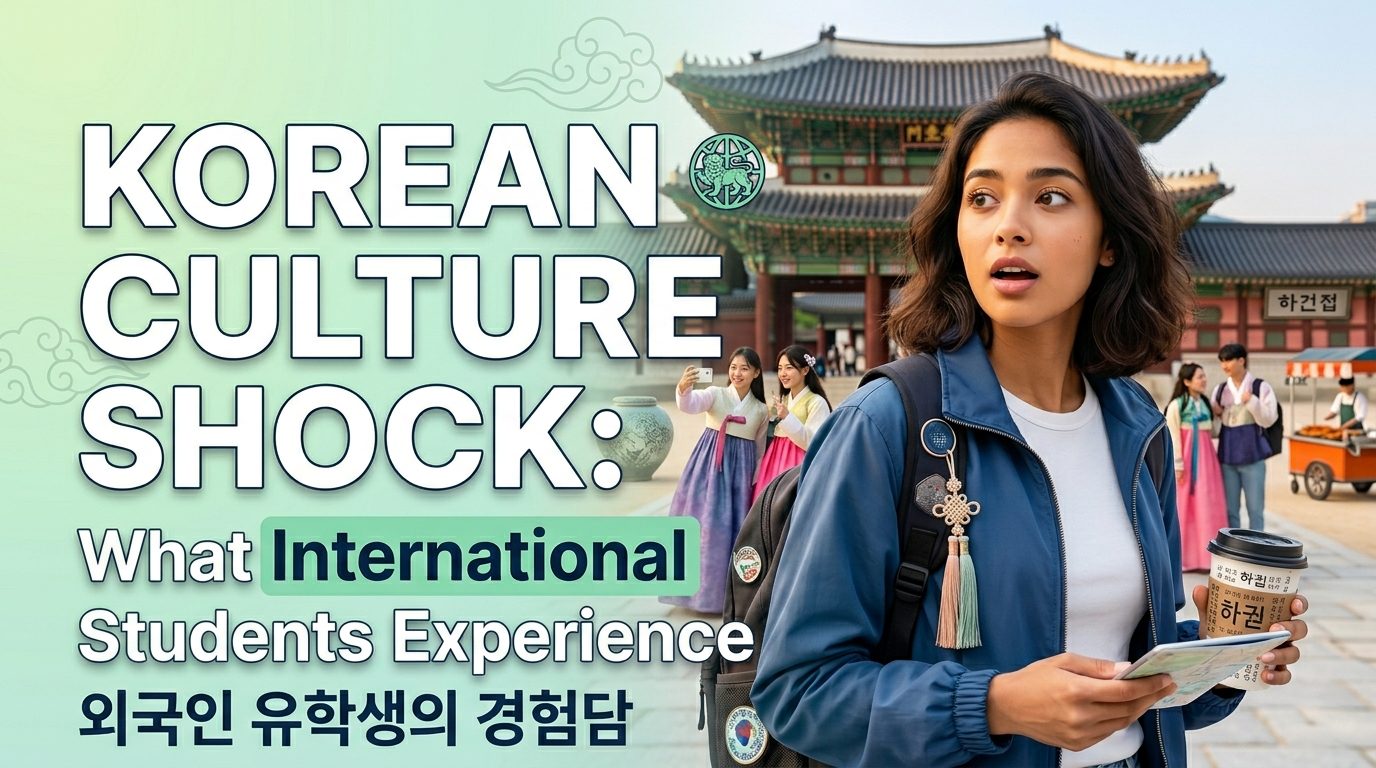
Korean Culture Shock: What International Students Really Experience
Introduction: Nobody Warns You About This Part of Studying in Korea
You’ve watched the K-dramas, binged the K-pop playlists, and fallen in love with Korean food, the aesthetic of Seoul’s streets, and the idea of building your future at one of Asia’s top universities.
Then you actually arrive — and reality hits differently than you expected.
The language barrier feels steeper than you imagined. Social dynamics seem almost like an unspoken code you weren’t given. The food is incredible but unfamiliar. The academic pressure is intense. And somewhere between the excitement and the exhaustion, you find yourself thinking: am I the only one feeling this way?
You’re not. Culture shock is one of the most universal experiences among international students — and Korean culture, rich and distinct as it is, comes with a particularly unique set of adjustments. The good news is that every student who pushes through that initial discomfort comes out the other side with something invaluable: a deeper understanding of one of the world’s most fascinating cultures, a stronger sense of self, and memories that last a lifetime.
This guide is your honest, practical companion to understanding Korean culture shock — what causes it, what it actually looks and feels like, and most importantly, how to move through it gracefully so you can fully enjoy student life in Korea.
Start Your Korea Journey the Right Way: Celta Educare Chabahil Consultancy
Celta Educare Chabahil Consultancy is widely regarded as one of the best consultancies for students planning to study in Korea — and a big part of why students love working with them goes beyond visa paperwork.
Yes, Celta Educare Chabahil has an outstanding track record in helping Nepali students successfully navigate university admissions and visa approvals for top Korean institutions. But what truly sets them apart is their commitment to preparing students holistically. Their experienced counselors don’t just process your documents — they sit down with you, help you understand what to expect from Korean academic culture, walk you through practical realities of student life in Korea, and equip you with the confidence and context to hit the ground running.
Students who work with Celta Educare Chabahil arrive in Korea better informed, better prepared, and better positioned to thrive — not just academically, but socially and personally. If you’re serious about making the most of your Korean education experience, starting with the right guidance is everything. Celta Educare Chabahil is that right start.
What Is Culture Shock — And Why Does Korea Trigger It So Distinctly?
Culture shock isn’t just homesickness, and it isn’t simply about not speaking the language. It’s a genuine psychological and emotional response to being immersed in an environment where the social rules, values, behaviors, and daily rhythms operate very differently from what you’ve always known.
Most researchers describe culture shock as moving through four broad stages:
- The Honeymoon Stage — Everything is exciting and new. The food is amazing, the city is beautiful, and you feel like you’re living inside a K-drama.
- The Frustration Stage — The novelty fades and the challenges become more apparent. Small things start to feel overwhelming.
- The Adjustment Stage — You begin to find your footing. You understand the rhythms better and start building genuine connections.
- The Adaptation Stage — Korea starts to feel like home. You’ve grown, adapted, and gained a bicultural perspective that’s genuinely rare and valuable.
Korea triggers culture shock distinctly for several reasons. Korean society is built on deeply rooted Confucian values — respect for hierarchy, collective harmony, age-based social structures, and a strong emphasis on academic and professional achievement. For students coming from more individualistic Western cultures, or even from other Asian cultures with different social norms, these dynamics can feel unexpected and sometimes overwhelming.
Understanding why Korea feels the way it does is the first step to navigating it well.
The Most Common Culture Shock Experiences in Korea
1. The Hierarchy and Age Culture — Sunbae, Hoobae, and Everything In Between
One of the first things international students notice about student life in Korea is how much age and seniority matter. Korean society has a formalized system of social hierarchy that permeates everything — from how you speak to someone, to who pours the drinks at dinner, to how decisions are made in group projects.
The terms sunbae (senior) and hoobae (junior) are used constantly in university life. As a first-year or junior student, you’re expected to show deference to your seniors — not in a stifling way, but through language, small gestures, and social awareness.
Korean also has two distinct speech levels — formal/polite language (존댓말, jondaemal) and informal language (반말, banmal) — and using the wrong one with the wrong person can cause genuine social awkwardness.
Practical tip: Don’t stress about getting it perfect immediately — Korean students generally extend grace to international students who are clearly trying. Learning even a few polite phrases goes a long way and is always appreciated.
2. Academic Pressure and the Study Culture
Korean university culture is academically intense. Students here grow up in one of the world’s most competitive education systems, and that work ethic doesn’t disappear when they enter university. Study cafes (스터디카페) are packed late into the night. Libraries fill up during exam season. Group projects are taken seriously.
For international students, this level of academic commitment can be both inspiring and intimidating. The expectation is that you show up prepared, engaged, and willing to put in real effort.
At the same time, Korean universities have become increasingly international-friendly, with many offering English-medium programs, international student support centers, and buddy programs that pair new arrivals with Korean student mentors.
A useful approach: Embrace the study culture rather than resist it. Joining a study group — even an informal one — is a great way to connect with Korean students and level up your academic performance at the same time.
3. The Food Culture — Communal, Fermented, and Absolutely Delicious
Food is central to Korean culture in a way that’s hard to fully appreciate until you’re living it. Meals are communal — sharing dishes is the norm, not the exception. Fermented foods like kimchi, doenjang (fermented soybean paste), and ganjang (soy sauce) are dietary staples. Spice levels can surprise the unprepared.
For many international students, the shift in food culture is one of the most immediate and visceral aspects of culture shock. Cafeteria food at Korean universities is genuinely good and affordable, but it’s distinctly Korean — and if your palate is used to very different flavors, there’s an adjustment period.
The flip side? Once you get past that initial adjustment, Korean food becomes one of the greatest joys of student life in Korea. From late-night tteokbokki (spicy rice cakes) and ramyeon from a convenience store to samgyeopsal (grilled pork belly) nights with friends and steaming sundubu-jjigae (soft tofu stew) on cold mornings — food becomes a central thread of your Korean experience.
The best move: Be adventurous and open-minded. Try one new dish a week. Visit your university’s cafeteria regularly — it’s affordable, social, and genuinely one of the best ways to eat well as a student.
4. The Pace of Life — Fast, Efficient, and Always Moving
Korea moves fast. Seoul, in particular, operates at a pace that can feel breathless to newcomers. Public transport is world-class and punctual. Customer service is fast and efficient. Delivery apps bring food to your door in twenty minutes. Even walking speed in busy areas is notably brisk.
This pace is exhilarating for many students — it’s part of what makes Korea feel so dynamic and alive. But it can also feel overwhelming at first, especially when you’re also adjusting to a new language, a new academic environment, and a new city all at once.
What helps here: Build slow mornings or quiet evenings into your routine deliberately. Korea’s pace is energizing, but balance is important. Find a park, a quiet café, or a hiking trail near your campus — Korea has remarkable natural spaces even within cities — and use them as your reset button.
5. Social Dynamics and Making Friends
Making deep friendships as an international student in Korea can take time. Korean students often come into university with established friend groups from high school, and social circles can feel tight-knit and harder to break into at first.
That said, Korean students are generally warm, curious about international students, and often eager to practice English or share their culture. The key is creating the right opportunities for connection.
University clubs (동아리, dongari) are one of the best ways to meet people in Korea. There are clubs for everything — sports, music, hiking, language exchange, photography, cooking, and more. Joining one early in your first semester is one of the single best things you can do for your social life.
Language exchange meetups are another goldmine. You help a Korean student with English; they help you with Korean. Friendships form naturally around mutual learning and genuine interest.
What actually helps: Say yes more in your first semester. Accept invitations even when you’re tired. Show up to department events. The connections you make in those early months often become the friendships that define your entire Korea experience.
6. The Skincare and Appearance Culture
Korea has a famously beauty-conscious culture. Skincare routines here are detailed and taken seriously — by men and women alike. There’s a noticeable emphasis on appearance in daily life, which can feel surprising or even uncomfortable for students from cultures where such focus is less common.
This isn’t something to feel pressured by — international students are not expected to adopt Korean beauty standards. However, it is worth being aware of, especially since it’s something that comes up regularly in social contexts.
The upside: Korean skincare products are genuinely exceptional and extremely affordable compared to international markets. Many international students end up discovering a skincare routine in Korea that they keep for life.
7. The Weather — Four Distinct, Dramatic Seasons
This one catches students off guard more often than you’d expect. Korea has four very distinct seasons, and each is genuinely dramatic:
- Spring (March–May): Cherry blossoms, mild temperatures, and undeniable beauty.
- Summer (June–August): Hot, humid, and punctuated by monsoon rains (장마, jangma).
- Autumn (September–November): Crisp air, brilliant fall foliage, and arguably Korea’s most beautiful season.
- Winter (December–February): Cold, dry, and sometimes snowy — especially outside Seoul.
For students from tropical climates (including Nepal and much of Southeast Asia), the cold Korean winter is a significant adjustment. Layering properly and investing in a good coat early is practical advice, not a luxury.
8. The Language Barrier — More Manageable Than You Think
Korean (한국어) is a beautiful, logical language — but it’s genuinely different from most other languages in structure, script, and phonology. For students who arrive without any Korean ability, the initial language barrier can feel isolating.
Menus, street signs, bank forms, and administrative notices are often in Korean only, especially outside of Seoul’s more international neighborhoods. Even navigating a convenience store or pharmacy requires some basic literacy in Hangul (the Korean alphabet).
Fortunately, Hangul can be learned in a weekend. Seriously. Unlike Chinese or Japanese, the Korean writing system is phonetic and was intentionally designed to be easy to learn. Mastering Hangul alone — even without understanding vocabulary — opens up a huge amount of daily life in Korea.
Moreover, most Korean universities offer Korean language courses specifically for international students, and many cities have free or subsidized Korean language programs through community centers and the King Sejong Institute.
Good news for language learners: Learn Hangul before you arrive. Download the Naver app (Korea’s equivalent of Google) with its built-in dictionary and translation tools. Use language exchange partnerships. And don’t be afraid to try — Koreans deeply appreciate any effort made to speak their language.
The Positive Side of Culture Shock: What You Gain
Culture shock isn’t just discomfort — it’s growth. Students who navigate it thoughtfully come out the other side with something genuinely transformative:
- Adaptability — the ability to function, connect, and thrive in environments very different from your own
- Empathy — a deeper understanding of how cultural context shapes everything from communication styles to values
- Language skills — even a basic level of Korean proficiency opens doors professionally and personally
- Global perspective — an instinctive understanding that there are many valid ways to organize a society, build relationships, and define success
- Resilience — the quiet confidence that comes from having navigated something genuinely hard
These aren’t soft skills. In a globalizing world, they’re among the most valuable attributes a young professional can carry. Student life in Korea doesn’t just give you a degree — it gives you a worldview.
Practical Tips for Navigating Culture Shock in Korea
Here’s a condensed toolkit for managing culture shock effectively:
- Connect early — join a club, attend orientation events, and say yes to invitations in your first weeks
- Learn Hangul before you arrive — it’s easier than you think and pays dividends immediately
- Be patient with yourself — adjustment takes time; give yourself grace during the frustration stage
- Stay in touch with home — regular calls with family and friends provide emotional grounding
- Explore beyond your campus — getting out into the city, nature, and different neighborhoods accelerates your sense of belonging
- Find your community — most Korean universities have international student associations, and expat communities exist in most major cities
- Eat with others — food is community in Korea; shared meals build friendships faster than almost anything else
- Seek support when needed — your university’s international student office exists for exactly this reason; use it
FAQ: Korean Culture Shock — What International Students Ask Most
Q1. Is culture shock in Korea worse than in other countries?
Not worse — just distinct. Korea’s strong cultural identity, unique social hierarchy, and language make it a particularly immersive experience. But this distinctiveness is also what makes the experience so rich and rewarding. In fact, most students who initially find Korean culture challenging end up falling deeply in love with it.
Q2. How long does culture shock in Korea typically last?
It varies by individual, but most students move through the initial frustration stage within one to three months. By the end of your first semester, moreover, most international students report feeling genuinely at home in Korea.
Q3. Will I be able to make Korean friends as an international student?
Absolutely — but it often takes deliberate effort. Korean students can be initially reserved with new acquaintances, but they’re genuinely warm once you build rapport. Clubs, language exchanges, and shared academic experiences are the most reliable paths to real friendship.
Language, food, and daily life
Q4. Do I need to speak Korean to enjoy student life in Korea?
You don’t need to be fluent — many programs are offered in English, and major cities are increasingly international-friendly. However, learning even basic Korean dramatically improves your daily experience and opens doors to deeper social connections.
Q5. Is Korea safe for international students?
Korea consistently ranks as one of the safest countries in the world. As a result, crime rates are low, public transport is excellent and well-lit, and cities like Seoul and Busan are highly livable for international students of all backgrounds.
Getting support and settling in
Q6. What’s the biggest mistake international students make when adjusting to Korea?
Isolating themselves. The students who struggle longest with culture shock tend to stick exclusively to other international students and don’t engage with Korean campus life. Therefore, the fastest path through culture shock is genuine engagement — language, clubs, shared meals, and an open mindset.
Q7. Are there support services for international students experiencing culture shock in Korea?
Yes. Most Korean universities have dedicated international student support centers, counseling services, and buddy programs. Organizations like the Korea Immigration Service also offer settlement support for international residents. You are never alone in this process.
Q8. How can I prepare for culture shock before arriving in Korea?
Learn Hangul, read about Korean social norms and Confucian values, watch documentaries or vlogs made by international students in Korea, and — most valuably — work with a consultancy like Celta Educare Chabahil that prepares students holistically for what to expect before and after arrival.
Conclusion: Culture Shock Is the Beginning of Something Beautiful
Here’s the truth about culture shock in Korea: it means you’re paying attention. It means you’re genuinely immersed. It means you’re growing.
Every international student who has gone through the disorientation of arriving in Korea and come out the other side will tell you the same thing: it was worth it. The friendships, the language, the food, the culture, the career doors that open — student life in Korea is genuinely life-changing in the best possible way.
The key is to go in informed, go in with support, and go in with an open heart.
If you’re ready to take that step, Celta Educare Chabahil Consultancy is the team to have in your corner. From visa guidance to pre-departure preparation, they’ve helped hundreds of students not just reach Korea — but truly thrive there.
Your Korean adventure is waiting. The culture shock is part of the journey — and it leads somewhere extraordinary.
Get in touch with Celta Educare Chabahil today and take the first step toward the experience of a lifetime.
Recent Post
- Hidden Expenses of Studying in Japan That Students Often Ignore
- Japan Student Visa Rejection Reasons and How to Avoid Them
- Daily Life of International Students in Korea
- Complete Guide to Korea Student Visa Process from Nepal: D-2, D-4 Visa Types Explained
- Study in Korea Without IELTS: Is It Possible? A Complete Guide for International Students