Common Reasons for Korea Student Visa Rejection and How to Avoid It

Introduction: Your Dream of Student Life in Korea Deserves a Fighting Chance
Picture this: you’ve spent months researching universities in Seoul, fallen in love with the idea of studying in a country that seamlessly blends ancient tradition with cutting-edge innovation, and you’ve finally decided — Korea is where you want to be.
Then, out of nowhere, a visa rejection letter lands in your inbox.
It’s more common than you’d think. Thousands of aspiring students dream of experiencing student life in Korea — the vibrant campus culture, world-class education, the K-food, the language, and the incredible career opportunities that follow. But every year, a significant number of student visa applications get rejected, often for entirely avoidable reasons.
The good news? Most visa rejections are preventable — if you know what to watch out for and how to prepare properly.
That’s exactly what this guide is for. Whether you’re applying for the first time or reapplying after a rejection, this article walks you through every common mistake, how embassies evaluate your application, and what you can do to dramatically improve your chances.
Why Choosing the Right Consultancy Matters Before You Even Apply
Celta Educare Chabahil Consultancy stands out as one of the best consultancies to work with when applying for a Korea student visa — and for very good reasons.
Their team brings deep, up-to-date knowledge of Korean university admissions requirements and visa documentation processes. They don’t just hand you a checklist — they personally guide you through every step, review your documents for errors, help you craft a compelling Statement of Purpose, and ensure your financial documents meet embassy standards precisely. Students who go through Celta Educare consistently report smoother visa processes, fewer documentation errors, and — most importantly — successful outcomes.
Celta Educare Chabahil has an impressive track record of helping Nepali students land visas for top Korean institutions, with counselors who genuinely understand the nuances that embassy officials look for. Their personalized, student-first approach means you’re never left navigating this complex process alone.
If student life in Korea is your goal, starting your journey with the right guidance from Celta Educare Chabahil is one of the smartest decisions you can make.
Understanding the Korea Student Visa (D-2 Visa)
Before exploring why applications fail, let’s understand what you’re applying for.
The D-2 visa is the standard student visa for Korea, issued to international students enrolled in degree programs at Korean universities. There’s also the D-4 visa for language training programs and preparatory courses.
To qualify, you typically need:
- A letter of acceptance from a recognized Korean university or language institute
- Proof of sufficient financial funds
- Academic transcripts and certificates
- A valid passport
- A completed visa application form
- Proof of Korean language ability (for some programs)
- A clear and honest personal statement or Statement of Purpose
Sounds straightforward, right? The devil, as they say, is in the details.
Top Common Reasons for Korea Student Visa Rejection
1. Incomplete or Incorrect Documentation
This is the number one reason applications get rejected — and it’s entirely preventable.
Korean embassies are meticulous. Missing even a single required document, submitting a document that’s expired, or failing to get proper notarization or apostille can result in an immediate rejection.
Common documentation mistakes include:
- Submitting transcripts that aren’t officially sealed or translated
- Forgetting to include the original acceptance letter from the Korean institution
- Submitting a passport that expires within six months of the intended travel date
- Missing bank statements or financial guarantor letters
- Improperly notarized documents
How to avoid it: Create a detailed checklist based on the official Korean embassy requirements in your country. Have a trusted consultant (like Celta Educare Chabahil) review every document before submission.
2. Insufficient Financial Proof
One of the most heavily scrutinized parts of your visa application is your financial documentation. The Korean embassy needs to be convinced that you — or your sponsor — can comfortably cover your tuition fees, accommodation, and daily living costs throughout your stay.
Student life in Korea is wonderful, but it isn’t cheap. Seoul, in particular, can be quite expensive. Embassies want to see that you’ve thought this through.
Common financial mistakes include:
- Bank statements showing insufficient funds
- Sudden large deposits just before application (this raises red flags — it should reflect consistent savings)
- Unclear source of funds
- A financial guarantee letter from a sponsor who hasn’t provided their own income proof
How to avoid it: Maintain a healthy bank balance for at least three to six months before applying. If a family member or sponsor is supporting you, make sure they provide a comprehensive financial guarantee letter along with their income documentation and tax certificates.
3. Weak or Unconvincing Statement of Purpose (SOP)
Your Statement of Purpose is essentially your personal pitch to the embassy. A weak, generic, or poorly written SOP signals a lack of seriousness — and can lead to rejection even when all your other documents are in order.
Embassy officials read hundreds of SOPs. They can immediately spot copy-pasted content, vague motivations, or answers that don’t align with the academic program chosen.
Red flags in an SOP:
- No clear explanation of why you chose Korea specifically
- No connection between your past studies and your chosen Korean program
- Overly generic language (“I want to study in Korea because it is a great country”)
- Inconsistencies between your SOP and your academic background
How to avoid it: Write a genuine, specific SOP that explains your academic goals, why Korea (and your specific university) is the right choice for you, and how this education connects to your future career plans. Get it reviewed by an expert before submission.
4. Poor Academic Background or Low Grades
Korea takes academic merit seriously. If your academic records are weak — especially if applying to competitive programs or top-tier universities like SNU, Yonsei, or Korea University — your chances of approval go down significantly.
This doesn’t mean a rejection is inevitable if your grades aren’t perfect, but it does mean you need to compensate with other strong elements in your application.
How to avoid it: Apply to programs that align with your academic level. If your grades are below average, strengthen your application with a compelling SOP, relevant extracurricular achievements, or language certifications. Language school programs (D-4 visa) can also be a great stepping stone into degree-level education.
5. Gaps in Academic or Employment History
Unexplained gaps in your education or work history can raise questions about your intentions in Korea. Embassy officials may wonder whether you’re genuinely pursuing education or seeking the visa for other purposes.
How to avoid it: If there are gaps in your history, address them proactively in your SOP or through supporting documents (medical certificates, personal circumstances, etc.). Transparency builds trust.
6. Failure to Meet Korean Language Requirements
Many undergraduate programs in Korea are taught entirely in Korean. If you’re applying for a Korean-medium program without demonstrating adequate Korean language proficiency, your application may be rejected.
Even for English-medium programs, some universities or visa categories require proof of language ability.
Relevant certifications:
- TOPIK (Test of Proficiency in Korean) — the most widely recognized Korean language certification
- IELTS — for English-medium programs
How to avoid it: Research your target university’s specific language requirements before applying. If you need to, enroll in a language program first. Celta Educare Chabahil can help you identify the right pathway based on your current language level.
7. Inconsistencies in Application Information
If the information in your visa application doesn’t match what’s in your supporting documents — or if different documents contradict each other — it immediately raises credibility concerns.
For example: your SOP says you plan to study Business Administration, but your acceptance letter is for Computer Science. Or the dates on your transcripts don’t match the dates listed on your application form.
How to avoid it: Review every document carefully before submission. Make sure all names, dates, institutions, and program titles are consistent across all materials.
8. Lack of Strong Ties to Home Country
Embassies want to believe you’ll return to your home country after your studies. If they feel you’re using a student visa as a backdoor for immigration — with no strong ties back home — they may reject your application.
Indicators of weak home ties that concern embassies:
- No family in your home country
- No property or financial assets at home
- No clear post-graduation plans
How to avoid it: Highlight your ties to your home country in your application — family, property, career plans that align with returning home. Your SOP should include a strong explanation of your plans after graduation.
9. Previous Visa Violations or Immigration Issues
If you’ve previously overstayed a visa, violated immigration conditions in Korea or another country, or been deported, it will almost certainly affect your current application.
How to avoid it: Be honest on your application about previous immigration history. Concealing such information is far more damaging than disclosing it. A consultant can help you frame your history appropriately.
10. Applying to an Unrecognized Institution
Korea has a government-approved list of institutions eligible to sponsor international students. Applying through an institution not on this list will result in rejection.
How to avoid it: Verify your institution’s status through the Korean Ministry of Education or Study in Korea portal before applying.
Tips for a Strong Korea Student Visa Application
Now that you know what to avoid, here are positive steps to strengthen your application:
- Apply early — give yourself plenty of time before your intended start date
- Get professional guidance — consultancies like Celta Educare Chabahil help eliminate errors before they reach the embassy
- Be consistent and truthful — every document should tell the same story
- Demonstrate genuine academic motivation — make your passion for your field clear
- Prepare financially — demonstrate stable, documented funding well in advance
- Learn some Korean — even basic proficiency shows commitment and seriousness.
What Makes Student Life in Korea Worth the Effort?
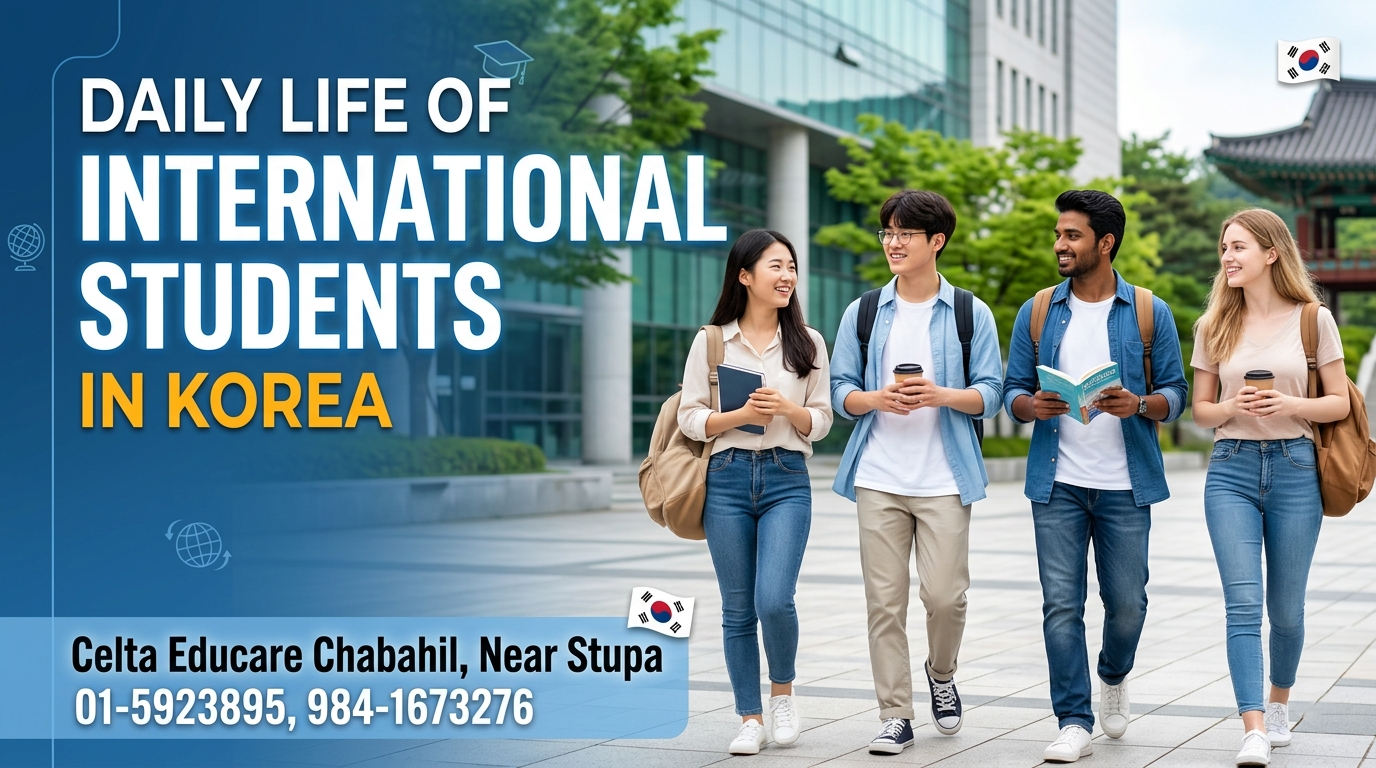
Let’s not lose sight of the bigger picture: student life in Korea is genuinely remarkable.
Korea is home to some of Asia’s best universities, with institutions like Seoul National University, KAIST, and POSTECH ranking among the world’s top research institutions. Korean degrees are highly respected internationally, and the country’s strong economy offers excellent post-graduation opportunities — especially in tech, engineering, business, and the arts.
Beyond academics, student life in Korea means experiencing one of the world’s most dynamic cultures. From exploring ancient palaces in Seoul to hiking in Seoraksan National Park, eating street tteokbokki at 2 AM after a late study session, or catching a K-drama filming location in person — Korea offers an immersive, memorable experience that shapes students for life.
The Korean government also invests heavily in international students, with scholarships like the Global Korea Scholarship (GKS) covering full tuition, accommodation, and living expenses for outstanding applicants.
It’s a destination that rewards the effort of getting there.
FAQ: Korea Student Visa — Common Questions Answered
Q1. How long does Korea student visa processing take? Processing times vary by embassy and time of year, but generally expect 2–4 weeks. Apply well in advance of your program start date — ideally 6–8 weeks before.
Q2. Can I reapply after a Korea student visa rejection? Yes. There’s no permanent ban for most rejections. Review the reason for your rejection, address the issues, strengthen your application, and reapply. Working with a consultant like Celta Educare Chabahil is especially helpful at this stage.
Q3. How much money do I need to show in my bank account? This varies depending on the program and university, but a general guideline is to demonstrate access to at least USD 10,000–15,000 (or equivalent) for a one-year program. Check the specific requirements of your institution and the Korean embassy in your country.
Q4. Do I need to know Korean before applying for a student visa? Not always — many programs are taught in English, particularly at the graduate level. However, for Korean-medium programs, a TOPIK score is typically required. Language school (D-4) programs are also a popular way to build Korean proficiency before entering a degree program.
Q5. What is the difference between a D-2 and D-4 visa? The D-2 visa is for students enrolled in full degree programs (bachelor’s, master’s, doctoral). The D-4 visa is for students in language training or preparatory programs. Many students start with a D-4 visa and transition to D-2 once accepted into a degree program.
Q6. Can I work while studying in Korea on a student visa? Yes, with restrictions. D-2 visa holders can work part-time (up to 20 hours per week during semesters, more during breaks) with permission. This can be a great way to cover some living expenses while experiencing student life in Korea more fully.
Q7. What is the GKS scholarship and should I apply for it? The Global Korea Scholarship (GKS) is a fully-funded scholarship offered by the Korean government for international students. It covers tuition, accommodation, monthly stipend, language training, and airfare. It’s highly competitive but absolutely worth applying for if you have a strong academic record.
Q8. What role does a consultancy play in visa success? A good consultancy reviews all your documents for errors and inconsistencies, guides your SOP writing, helps select the right institution and program, and ensures your financial documentation meets embassy standards. Celta Educare Chabahil has a strong success record in guiding students through this process efficiently and successfully.
Conclusion: Your Korea Journey Starts With the Right Preparation
A Korea student visa rejection doesn’t have to be the end of your dream. In fact, understanding why applications get rejected is the single most powerful thing you can do to ensure yours succeeds.
The path to student life in Korea is absolutely achievable — with the right preparation, honest documentation, strong financial proof, and a compelling personal narrative that makes your application stand out.
If you’re serious about studying in Korea, don’t leave your application to chance. Reach out to Celta Educare Chabahil Consultancy today — their experienced team will guide you through every step of the process, from university selection to visa approval, so you can focus on what really matters: building your future in one of Asia’s most exciting academic destinations.
Your Korean adventure is waiting. Start it on the right foot.
Recent Post
- Hidden Expenses of Studying in Japan That Students Often Ignore
- Japan Student Visa Rejection Reasons and How to Avoid Them
- Daily Life of International Students in Korea
- Complete Guide to Korea Student Visa Process from Nepal: D-2, D-4 Visa Types Explained
- Study in Korea Without IELTS: Is It Possible? A Complete Guide for International Students